Pages

Tuesday, 6 July 2010

Bitter Centres


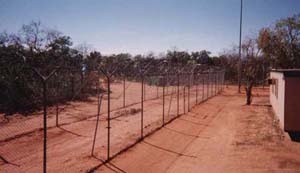
What blooms are these,
flowering in the wilderness?
What fruits of civilization ripen here,
carefully tended in such barren sands?
Far out where hopes of welcome blossom.

What filigree threads
dance on the perspiring horizon,
flowing like silver gossamer?
A pretty spider web of steel.

Moving closer, there are no ordered woods and gardens here,
but strange things sprout:
perhaps these cultures are just persistent weeds -
or beauty rich and rare?

On this golden soil of our wide brown land,
we are surely young and free -
but
not even the timeless desert will erase
our high tech steel alloy
razor wire
curling through the desert like a many-fanged serpent
biting the hearts of mothers.

And all around we feel this strange precipitation on the sand –
Could it be spring blossom from some hidden oasis, carried by the breeze?
Or the bleak leaves of autumn wafted to this desolate spot?
Or is it the gentle, mourning rain
of those who took us at our word
and sought our help?

Monday, 5 July 2010

Unravelling borders

A child asylum seeker

Curtin Detention Centre - recently reopened. The buildings are not insulated. This photo was taken by an asylum seeker.

The government has been framing the debate about asylum seekers in the language of "border protection".

We delineate boundaries over land (and sea) to divide jurisdiction, and people cross those borders all the time.

The act of crossing a border does not violate it. When someone seeks the protection of our jurisdiction, they generally have to cross over the border to obtain the protection of that jurisdiction. There is no need to protect our borders from such people - they are relying on those borders, not threatening them.

That is what seeking asylum means - asking for our help.

If an army were to cross the border, with the object of overthrowing the government, that would be a different matter. To suggest that people fleeing persecution, and seeking sanctuary here, are to be categorized in such a way, is to leave the path of reason.

Australia was instrumental in developing the Refugee Convention in 1951. This was a response to the denial of asylum to Jewish refugees - notably aboard the St Louis in its doomed attempt to take threatened Jews out of Nazi Germany in 1939. We are signatories to the convention.

This week Julia Gillard will make an announcement about "border protection" because the three month suspension of Tamil claims for asylum will expire. Her use of the term "border protection" already shows us how she views this issue.

The right of Tamils (and Afghans) to claim asylum should never have been suspended. In fact, it is clear that the situation for Tamils in Sri Lanka remains dire, and many will be able to show a "well-founded fear of persecution". In Afghanistan, the UN has pulled all its personnel out because it is unsafe.

When there is hysteria about an issue, governments can exploit it for short term political gain, but they do damage to our nation in the process. Their real responsibility is to articulate the values to which we aspire, and to take leadership. Regrettably, that has not happened under Prime Ministers Rudd or Gillard.

The debate about asylum seekers in Australia is fundamentally about ourselves. It's about what sort of community we are and what sort of nation we are. We proclaim our values of freedom and justice, but when people fleeing unimaginable persecution take us at our word, and look to us for help, we lock them up in desert hell holes and we deny them the processes of our law.

Is this who we really are? Is this the legacy we want to leave?

External Links

Sunday, 4 July 2010

Greedy Gratuities


On 15th September 2008, Lehman Brothers filed for bankruptcy. It was the largest corporate collapse in history. It led to a spiralling collapse of sharemarkets and credit funding around the world, greatly exacerbating the Global Financial Crisis.

Lehman Brothers was heavily geared - it borrowed 31 times its capital asset base. Just a small downturn wiped out its book value.

When the business was liquidated, the real estate and data centres sold for $1.29 billion. The core business for $1.35 billion.

Hundreds of billions of dollars in Lehman Brothers debts were never satisfied.

There are many lessons from this corporate collapse, but the obscene part was the payout to executives. In 2007 alone the company paid $5.7 billion to senior executives in bonus payments. In 2008, in the leadup to the bankruptcy and even after it, the company and its executors were forced contractually to pay a further $2.5 billion to executives in bonus payments.

In other words, as Lehman Brothers was heading to its cosmic disintegration, executives were paid $8.2 billion in handouts for wrecking the company and causing untold financial misery around the world.

A century ago, the great capitalist barons made huge fortunes, but the money they risked was their own. Now, executives receive large bonuses risking other people's money - and they face no down side. They continue to get paid megabucks even when they act foolishly and destroy their company.

Is such a system rational?

Whenever the issue of excessive handouts to executives is raised, they answer that this is dictated by the market, and we have to remain competitive.

What complete bunkum.

Large companies have shareholdings in each other, and the executives of one company will sit on the board of another to protect their shareholding. When the executive salary issue comes up, they have every interest in keeping payments high - the favour will be returned when their own payments are considered. Far from market competition, it is market collusion.

Small shareholders in practice get very little say in executive payments - they are set by executives themselves.

Such a situation is capable of regulation, and should be. No performance bonus should be paid unless there is a corresponding performance penalty if things go wrong. Bonuses linked to short term gains should be outlawed, as often it is only in the longer term that the real financial position can emerge. The level of executive salaries can be controlled in a variety of ways - such as requiring a fixed relationship between the salary of the chief executive and the pay of the lowest-remunerated person in the corporation.

One thing is clear, the present system is no good for business - let alone the people whose lives are ruined by this excess.

External links

Saturday, 3 July 2010

Tall trees

A century ago, Gippsland settlers stand proudly round a giant tree they have ringbarked.

In 2008, in Tasmania’s southern forests, surveyors found the tallest known tree in Australia today. Standing 101 metres high, it is a magnificent find – higher than any tree we have known about for many decades. It is not, as some reports have suggested, the second tallest tree in the world - there are 16 trees in the US over 110 m in height, let alone 101. But Australia once had much taller trees.

On 21st February 1872, Victorian government surveyor and Inspector of State Forests William Ferguson reported to Mr Clement Hodgkinson, Assistant Commissioner of State Forests, on his inspection of “areas that had not been penetrated by the timber splitter or the woodcutter”: 


Some places, where the trees are fewer and at a lower altitude, the timber is much larger in diameter, averaging from 6 to 10 feet and frequently trees to 15 feet in diameter are met with on alluvial flats near the river. These trees average about ten per acre: their size, sometimes, is enormous. Many of the trees that have fallen by decay and by bush fires measure 350 feet in length, with girth in proportion. In one instance I measured with the tape line one huge specimen that lay prostrate across a tributary of the Watts and found it to be 435 feet from the roots to the top of its trunk. At 5 feet from the ground it measures 18 feet in diameter. At the extreme end where it has broken in its fall, it (the trunk) is 3 feet in diameter. This tree has been much burnt by fire, and I fully believe that before it fell it must have been more than 500 feet high. As it now lies it forms a complete bridge across a narrow ravine.

In other words, Ferguson measured the tree (in an area near Healesville) from its base to the point where it had broken off in its fall to be 435 feet (133 m) and did not measure its crown. Even at 435 feet, there is no tree on Earth known ever to have surpassed it. However, the information that the tree was still 3 feet in diameter at this point supports the estimate that the tree had been over 500 feet (152 m) high. This tree has become known as “the Ferguson tree”.

The tree found in Tasmania, like the Ferguson tree, is a mountain ash, although in that State they use the less impressive name “swamp gum”. Mountain ash (Eucalyptus regnans – monarch of the eucalypts) is still today the world’s tallest hardwood and the world’s tallest flowering plant, but there were several nineteenth century trees any one of which, if alive today, would be the tallest tree in the world, and the largest of all was the Ferguson tree - listed in the Guinness Book of Records as the tallest recorded tree.

The tallest Californian redwood currently standing is the newly-discovered ‘Hyperion’ of the Redwood State Park, standing 115.55 m tall (379 feet). The tallest North American tree ever known was a Douglas fir (Pseudotsuga menziesii) measured at 400 feet (122 m). Unlike Australia’s Ferguson Tree, the giant Douglas fir was not professionally measured, so must remain a tantalizing anecdote.

Other Australian trees of which we have reliable records from the nineteenth century are: 


  • A tree at Mt Baw Baw measured by surveyor G W Robinson prior to 1889 to be 470 feet (143 m). 

  • The Centennial Exhibition Tree from the Menzies Creek area, which was measured after felling at 400 feet (122 m). This tree was felled so that its spectacular trunk could be dismantled and then reassembled to form a display in the 1888 centennial exhibition in Melbourne. 
There are good photographs of this tree in the State Library of Victoria.
  • Fallen tree in the Dandenong ranges measured by surveyor David Boyle in 1862 to be 392 feet (119 m). Again the tree had broken in its fall, and Boyle estimated that the top would be another 30 feet, giving a total height of about 420 feet (128 m).

Trees which were huge but which would not top the highest remaining trees in North America are: 


  • Thorpdale tree in South Gippsland, felled in 1880 and then accurately measured by surveyor G Cornthwaite to be 375 feet high (114 m) 

  • Olongolah tree near Beech Forest in the Otways, which was measured by an unnamed Colac Shire Engineer on an unknown date prior to 1900 to be 347 feet (106 m). 

  • The “Neerim Giant” was measured by a government surveyor to be 325 feet (99 m). It had a broken top, however, and must once have been considerably taller. It was destroyed by fire early in the 20th century.

In 1939 in Toorongo Forest, Noojee, another fallen tree was measured by Inspector of Forests, F G Gerraty to be 348 feet (106 m).

It is a source of shame for Australians that our forefathers destroyed giant trees which, if they were living today, would be wonders of the world. Many huge trees were destroyed, and for many there are no measurements. In some cases, the trees were cut down and simply burnt, often in places so inaccessible that they would never be useful for grazing.

Trees were hunted down, and the challenge of destroying these ancient giants was taken on with gusto. Old photographs of people in the forest almost always show an axe present. It was as if this was a statement of manhood against the uncivilised immensity of the forest.

What does it take to have tall trees grow? One factor is time. Hundreds of years are needed for the trees to grow, but this is after millennia of nutrients building up as trees grow and decay. Another factor is a large area of forest. Trees grow upwards when competing for light, and can grow very tall when protected from wind and storm by a large number of other tall trees.

Might there be still taller trees out there? Perhaps the tallest tree in the world? Who knows? In the past few years we have discovered several new species of trees in East Gippsland, the Wollemi Pine in the Blue Mountains, and the world’s oldest known tree on Mt Read in Tasmania. And now we have found a tree which tops any tree found in Australia for many decades. We are still finding things in the Australian bush that we do not expect.

But we have lost so much already. In the nineteenth century people knew no better, but we know otherwise now. We know that logging causes a loss of water yield for up to 150 years, we know that there are very few people employed by the industry, we know that the industry enjoys substantial public subsidies, we know that endangered species are killed by logging. And we know, following studies by Professor Brendan Mackey and his team at ANU that for each hectare we log we lose an average of 1000 tonnes of carbon into the atmosphere – after taking replanting into account. We know there are ready and viable alternatives, including the use of plantation timber. We know that the alienation of our nation from its land is causing immense environmental and personal damage, with logging providing the most dramatic illustration.

It is time to stop.


External Links

Monday, 28 June 2010

Keep sport healthy

When a drunken Brendan Fevola disgraced himself at last year's Brownlow Medal night, the football community tut-tutted. But the AFL did not do the one thing it needed to do. It did not immediately stop sponsorship of the sport by large alcohol companies.

It was just one more in a string of scandals involving players and alcohol - to say nothing of the problems of fans and alcohol.

Last year the National Preventative Health Taskforce suggested banning alcohol sponsorship of sport, but the AFL was quick to protest. AFL boss Andrew Demetriou said such a ban would "cripple football".

The AFL lists as a Corporate Partner Fosters - the brewing group that makes beers like Carlton Draught and Victoria Bitter, as well as Wolf Blass wines. Individual clubs have other alcohol corporations as sponsors.

Sport is about healthy bodies in the peak of condition - something to which alcohol is anathema. When a brewing giant contributes money to a sport like the AFL, it doesn't do so in order to help sport. It does so to sell its product and return profits to shareholders. The lives damaged by excessive consumption of that product are not its concern.

Fosters is also a Commercial Partner of Cricket Australia - even though the captain of the team, Ricky Ponting, has admitted he has an alcohol problem, and Andrew Symonds has admitted to being an alcoholic. How much damage to players and fans will we tolerate so that brewers can make their profits?

Or take the Australian Grand Prix, which lists as sponsors
Don't we have a problem with drinking and driving in this country? On what possible basis can we support associating the two activities in such a prominent, sanctioned way?

It is extraordinary that the Melbourne Cup includes as its sponsors:
The marketing hype of bubbly, celebratory drinks hides the real ugliness of excessive drinking done at the profit of these sponsors. Check out these photos from Crikey - taken at Flemington on the afternoon of last year's Melbourne Cup.


We have a major problem with alcohol in Australia.

Alcohol-fuelled violence, binge drinking, and health problems are the product of an increasingly ugly alcohol culture, which the alcohol industry feeds for its profits. The rest of us pay for the harm caused by alcohol excess.

Wise leadership requires us to take steps to minimize this harm. Just as with tobacco, we should not permit any advertizing by the alcohol industry, but let's start by banning the bizarre sponsorship of sport by these socially harmful products.


External links

Friday, 25 June 2010

Dirty deals

Mining brown coal in the Latrobe Valley

In 1840 Count Paul de Strzelecki travelled through the ranges that now bear his name in South Gippsland. So dense was the forest cover that his party was reduced to felling trees and walking along the fallen trunks - far above the ground on a tangle of vegetation. They reached Westernport Bay a month late, with almost no equipment left, and starving.

Most of that forest was cleared in the 19th and 20th centuries, but there are a few magical patches left - especially in the Tarra-Bulga National Park, where I spent some holidays as a child.

20 million years ago, the forests covering what is now the Latrobe Valley were very similar to the forests through which Strzelecki struggled. As trees died and plant material compacted, they slowly formed brown coal. The layers of brown coal there are up to 400 metres thick. In places it is possible to see entire tree trunks in the upper layers where digging machines are cutting away at the deep seam.

The brown coal layer forms an insulation blanket, and research is under way to see whether the much higher temperatures below that blanket can be used to provide geothermal energy: if so, it will be important to keep the brown coal in place, so we don't let the heat dissipate.

But this week Victorian company Environmental Clean Technologies (don't you just love that name?) has signed the first deal to export Victorian brown coal. The company will send up to 20 million tonnes of processed brown coal to Vietnam every year. (ECT has also been involved in the oxymoronic "clean coal" business.)

Last year the Victorian Government stopped a similar export deal. But they have been studiously silent about this one.

Gillard government Trade Minister Simon Crean - who could veto the export - said that the export of brown coal was good for the economy.

He probably won't be around when we are dealing with the jobs lost from the Great Barrier Reef tourism industry - or the countless other benign industries which will be ruined by climate change.

Starting a new industry of shipping our dirty brown coal into third world countries to burn for fuel is crazy policy.

The signs of the climate crisis are in our face, and yet we are acting as though it is only a question of the money we can make now.

We've just seen a change of national leadership because of a failure to act on the climate crisis. This is a test of our new leadership.

Thursday, 24 June 2010

Will Julia succeed?


Will Julia Gillard succeed as Prime Minister in dealing with the issues facing Australia?

Kevin Rudd lost the trust of the Australian people - and his Prime Ministership - because he failed to take action on the climate crisis. Julia Gillard faces the same test.

Many people in the Melbourne electorate have told me they want real and immediate action on climate change and carbon emissions.

Here's some things she could do:
  • Pick up the phone and negotiate with the Greens for a proper solution to the climate crisis.
  • Join with the Greens (and at least two Coalition Senators) to pass a carbon tax - this would apply across all industries, not just mining, with the funds directed towards transitioning to a low carbon economy.
  • Remove perverse taxes that encourage fossil fuel use - such as car leases that require minimum kilometres to be driven, the diesel fuel rebate, and sundry others.
  • Allow tax deductions and/or salary packaging for people who cycle to work.
  • Ditch the $2 billion+ corporate welfare funding for "Clean Coal" geo-sequestration pipe dreams that defy the basic laws of physics, and direct this towards a 100% clean energy program based on concentrated solar with salt storage and wind power.
  • Commence planning for a very fast train project to link Adelaide, Melbourne, Canberra, Sydney and Brisbane.
  • Introduce national building standards for 6 Star Rated buildings and retrofit of existing building stock (remembering that proper management of these schemes is basic).
  • Protect native forests from logging to keep their carbon where it is, (and to secure our water supplies and to provide habitat for endangered species).
  • Outlaw the burning of native forest woodchips as a "renewable energy source" - it clearly is not renewable and our forests are worth much more than woodchips.
Over to you, Julia. You can do it, and you will be praised by history - and our grandchildren - if you do.