Pages

Showing posts with label Julia Gillard. Show all posts

Sunday, 18 July 2010

Values


“Change we can believe in” thundered the Obama campaign. “Hope” he offered, and even “Yes We Can”.

Here in Australia, during the 2007 campaign, our leaders were too shy to use inspiring words like “change” or “hope”. We rallied to the slogan “Kevin 07”.

But that did not mean that we did not yearn for hope, or that we did not believe in change.

Yesterday we saw the announcement of a federal election on 21st August. Labor leader Julia Gillard mouthed her mantra "moving forward" over 2o times in her speech. What does she mean by "moving forward"?

Julia Gillard did announce her "values":
  • hard work,
  • the importance of respect and valuing other people,
  • and "most importantly, the transformative power of a high quality education".
These are not values that should be dismissed - who could disagree with them? But they are an oddly narrow set of values and do not appear to have any connection to "moving forward".

Tony Abbott countered with his repeated slogan "real action". Presumably, as opposed to fake action or real inaction.

Slogans are an inevitable part of electioneering - they are a way to communicate a message succinctly, and hopefully, persuasively.

But when the slogan becomes the substance, we are in trouble. The slogan "moving forward" suggests progressive values, but there was no hint of such values in Julia Gillard's speech. It was a slogan without content. Empty sloganeering debases our political debate and disenfranchises the community.

Bob Brown gave his own content to the phrase:
Moving forward will mean a carbon tax on polluters, bringing home safely Australia's troops from Afghanistan, a universal dental care scheme, humane treatment of asylum seekers in Australia, protecting our forests and wildlife
Today we want our leaders to confront the great issues of our generation:
  • our relationship to the environment - sustainability;
  • our relationship with other nations - peace;
  • our relationship with each other: including giving the community power over the decisions that affect their lives - real democracy - and encouraging generosity and tolerance towards all sections of our society so that the creativity of our community can flourish and find its full expression - human rights.
With those values affirmed, we might have accepted the slogan "moving forward" - because our leaders really would be providing hope, and really would be working towards change we could believe in.

As it is, I can't wait for the spoofs.

Monday, 5 July 2010

Unravelling borders

A child asylum seeker

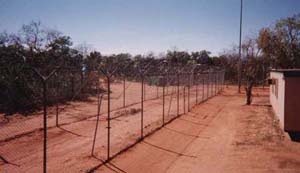
Curtin Detention Centre - recently reopened. The buildings are not insulated. This photo was taken by an asylum seeker.

The government has been framing the debate about asylum seekers in the language of "border protection".

We delineate boundaries over land (and sea) to divide jurisdiction, and people cross those borders all the time.

The act of crossing a border does not violate it. When someone seeks the protection of our jurisdiction, they generally have to cross over the border to obtain the protection of that jurisdiction. There is no need to protect our borders from such people - they are relying on those borders, not threatening them.

That is what seeking asylum means - asking for our help.

If an army were to cross the border, with the object of overthrowing the government, that would be a different matter. To suggest that people fleeing persecution, and seeking sanctuary here, are to be categorized in such a way, is to leave the path of reason.

Australia was instrumental in developing the Refugee Convention in 1951. This was a response to the denial of asylum to Jewish refugees - notably aboard the St Louis in its doomed attempt to take threatened Jews out of Nazi Germany in 1939. We are signatories to the convention.

This week Julia Gillard will make an announcement about "border protection" because the three month suspension of Tamil claims for asylum will expire. Her use of the term "border protection" already shows us how she views this issue.

The right of Tamils (and Afghans) to claim asylum should never have been suspended. In fact, it is clear that the situation for Tamils in Sri Lanka remains dire, and many will be able to show a "well-founded fear of persecution". In Afghanistan, the UN has pulled all its personnel out because it is unsafe.

When there is hysteria about an issue, governments can exploit it for short term political gain, but they do damage to our nation in the process. Their real responsibility is to articulate the values to which we aspire, and to take leadership. Regrettably, that has not happened under Prime Ministers Rudd or Gillard.

The debate about asylum seekers in Australia is fundamentally about ourselves. It's about what sort of community we are and what sort of nation we are. We proclaim our values of freedom and justice, but when people fleeing unimaginable persecution take us at our word, and look to us for help, we lock them up in desert hell holes and we deny them the processes of our law.

Is this who we really are? Is this the legacy we want to leave?

External Links

Friday, 25 June 2010

Dirty deals

Mining brown coal in the Latrobe Valley

In 1840 Count Paul de Strzelecki travelled through the ranges that now bear his name in South Gippsland. So dense was the forest cover that his party was reduced to felling trees and walking along the fallen trunks - far above the ground on a tangle of vegetation. They reached Westernport Bay a month late, with almost no equipment left, and starving.

Most of that forest was cleared in the 19th and 20th centuries, but there are a few magical patches left - especially in the Tarra-Bulga National Park, where I spent some holidays as a child.

20 million years ago, the forests covering what is now the Latrobe Valley were very similar to the forests through which Strzelecki struggled. As trees died and plant material compacted, they slowly formed brown coal. The layers of brown coal there are up to 400 metres thick. In places it is possible to see entire tree trunks in the upper layers where digging machines are cutting away at the deep seam.

The brown coal layer forms an insulation blanket, and research is under way to see whether the much higher temperatures below that blanket can be used to provide geothermal energy: if so, it will be important to keep the brown coal in place, so we don't let the heat dissipate.

But this week Victorian company Environmental Clean Technologies (don't you just love that name?) has signed the first deal to export Victorian brown coal. The company will send up to 20 million tonnes of processed brown coal to Vietnam every year. (ECT has also been involved in the oxymoronic "clean coal" business.)

Last year the Victorian Government stopped a similar export deal. But they have been studiously silent about this one.

Gillard government Trade Minister Simon Crean - who could veto the export - said that the export of brown coal was good for the economy.

He probably won't be around when we are dealing with the jobs lost from the Great Barrier Reef tourism industry - or the countless other benign industries which will be ruined by climate change.

Starting a new industry of shipping our dirty brown coal into third world countries to burn for fuel is crazy policy.

The signs of the climate crisis are in our face, and yet we are acting as though it is only a question of the money we can make now.

We've just seen a change of national leadership because of a failure to act on the climate crisis. This is a test of our new leadership.

Thursday, 24 June 2010

Will Julia succeed?


Will Julia Gillard succeed as Prime Minister in dealing with the issues facing Australia?

Kevin Rudd lost the trust of the Australian people - and his Prime Ministership - because he failed to take action on the climate crisis. Julia Gillard faces the same test.

Many people in the Melbourne electorate have told me they want real and immediate action on climate change and carbon emissions.

Here's some things she could do:
  • Pick up the phone and negotiate with the Greens for a proper solution to the climate crisis.
  • Join with the Greens (and at least two Coalition Senators) to pass a carbon tax - this would apply across all industries, not just mining, with the funds directed towards transitioning to a low carbon economy.
  • Remove perverse taxes that encourage fossil fuel use - such as car leases that require minimum kilometres to be driven, the diesel fuel rebate, and sundry others.
  • Allow tax deductions and/or salary packaging for people who cycle to work.
  • Ditch the $2 billion+ corporate welfare funding for "Clean Coal" geo-sequestration pipe dreams that defy the basic laws of physics, and direct this towards a 100% clean energy program based on concentrated solar with salt storage and wind power.
  • Commence planning for a very fast train project to link Adelaide, Melbourne, Canberra, Sydney and Brisbane.
  • Introduce national building standards for 6 Star Rated buildings and retrofit of existing building stock (remembering that proper management of these schemes is basic).
  • Protect native forests from logging to keep their carbon where it is, (and to secure our water supplies and to provide habitat for endangered species).
  • Outlaw the burning of native forest woodchips as a "renewable energy source" - it clearly is not renewable and our forests are worth much more than woodchips.
Over to you, Julia. You can do it, and you will be praised by history - and our grandchildren - if you do.