Pages

Showing posts with label Greens. Show all posts

Sunday, 25 February 2018

A Violent Joke

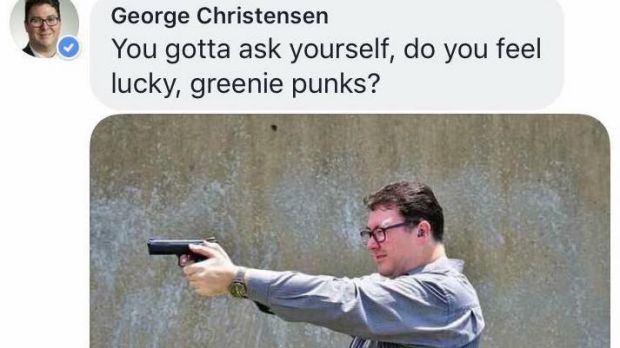
George Christensen's post

Last week, George Christensen posted on Facebook a photograph of himself aiming a pistol, with the caption 'You gotta ask yourself, do you feel lucky, greenie punks?'

It was the day after a school massacre in Florida.

Christensen is the LNP MP for Dawson, in Queensland. He caucuses with the National Party.

The Prime Minister described Christensen's post as 'very inappropriate'.

Christensen refused to apologise, describing the post as a 'joke'. It is not so clear that was the original intention.

He edited the caption to read 'You gotta ask yourself, do you have a sense of humour, greenie punks?' A short time later he deleted the post.

The post was referred to police. Queensland police quickly announced they would take no action. At the time of writing, the AFP are still considering the matter.

Following Christensen's post, Greens Senator Sarah Hanson-Young received an email, with the subject 'bullets' that read: 'Hopefully George has one left in the chamber to fire directly into your vagina you hysterical fucking cunt'.


Christensen's post is no joke.

Christensen's gun-pointing threat to 'greenie punks' comes in a context. There has been sustained and serious violence against Greens and environmental protesters over many years. Most has been perpetrated by the very people to whom Christensen appeals for votes.

In March 1986, during the protests against the Farmhouse Creek logging in Tasmania, Bob Brown was walking down a bush road with conservationist Judy Richter and journalist Hugh Maclean. Shots rang out, evidently aimed at Bob. Maclean, with his Vietnam training, immediately dropped to the mud, leaving the other two standing in shock. Later the shooter was arrested. He was charged with discharging a firearm on a Sunday and fined $200.

Bob Brown manhandled by loggers at Farmhouse Creek in 1986. Later he was shot at.

In January 1990 I was present in a conservationists' camp when two shots were fired in the bush close by. The perpetrator made off. Police in Orbost refused even to take a statement.

In 1991 two cars belonging to conservationists were destroyed by gelignite in the East Picton forest of Tasmania.

In the late 1990s an attempt was made to sabotage the aircraft of Vince Jones, the jazz singer. He lived near Buchan, and was vocal about logging. Steel wool was cut up and deposited in his light aircraft's fuel tank.

In December 1998 Adrian Whitehead was assaulted with an axe handle by a logger. He had been conducting a botanical survey at the time. Despite having an independent witness, the police refused to lay charges.

Adrian Whitehead after being bashed by a logger

After midnight on 3 December 1998 a group of loggers smashed up a campsite of conservationists in the Otways, yelled threats, and drove a vehicle into a tent occupied by two female conservationists who feared for their lives. One logger was subsequently charged and convicted in relation to this incident.

In December 1998 Peter Stienke (“Fisherman Pete”) was by himself minding a conservationists’ camp at Goolengook over Christmas. His car was found at the camp with the door open and food and drinks on the passenger seat. Despite a search by police, Fisherman Pete was never found and is missing, presumed dead. He left a 14 year old son.

On 20 February 2000, some 40 to 50 loggers - some with their children - converged from Orbost and Bombala on a conservationists’ camp in the forest of East Gippsland. They trashed the camp and beat up a Canadian tourist who was there. A carload of conservationists drove up. The conservationists were violently attacked and the car reduced to a wreck. The loggers caused severe injuries to two persons, and threatened to rape the women present.

Much of this was recorded on audio, and it makes chilling listening. The out of control ranting of the loggers, the smashing of iron bars against machinery and people – and the futile attempts of the conservationists to calm the loggers down.

Some of the loggers were identified and later convicted.

On 2 April 2000 loggers wielding baseball bats and axe handles attacked a conservationists' camp at Middle Spur in the Otway Ranges. Police and ambulance were called. Some twenty conservationists were injured, five being hospitalised.

In October 2008 logging vigilantes firebombed two cars belonging to conservationists that were parked on the Strathgordon Road in the Upper Florentine Valley.

There is nothing funny about George Christensen's gunwielding antics against Greenies. Exhortations to violence – whether against greenies, blacks, women, Jews, gays, or any other group in society – are shameful. 'Jokes' like this give licence to those who are inclined to resort to violence, and there are too many of those already.

Political appeals based on violence have a way of spiralling into enormous harm. I can only hope Christensen's gun-toting example will not lead to further violence against conservationists. 

I very much fear it will.

External links

Tuesday, 30 December 2014

Labor and the Hard Right

Reflections on preferences in the 2014 Victorian election


Election night - 29 November 2014


In the 2014 Victorian election, the Greens made history again - breaking into the lower house with two seats (Melbourne and Prahran) and increasing their upper house representation from 3 to 5 members.

Labor won government in the lower house with 47 of the 88 seats. 

Composition of the Upper House

In the 40 seat Legislative Council (upper house), Labor lost two seats, moving from 16 seats down to 14 - well short of a majority.

The Liberals also have 14 seats, and are joined by the Nationals with 2. The Greens have 5 seats, increased from the 3 they held before the election.

The balance of the chamber comprises 2 representatives of the Shooters and Fishers Party, 1 representative from the Democratic Labour Party, 1 from the Australian Sex Party and 1 from Vote 1 Local Jobs.

Labor now complains about this result, but Labor played its part in bringing it about.

Labor preferencing right wing candidates

In this election, as in previous elections since the upper house was enfranchised in this way (the first of these was 2006) the Labor party in Victoria has preferenced right wingers and succeeded in having them elected.

This first occurred in 2004, at the Federal level, when Labor preferences in Victoria were instrumental in electing Family First's Steve Fielding to the Senate, knocking out the Greens' David Risstrom. Fielding, who in his own right had won just 1.88% of the primary vote, proved a bizarre representative. He opposed any action on climate change. He said that same sex marriage was akin to incest. He even opined that young women would deliberately get pregnant so they could claim parental leave payments, and then have a late term abortion. Thanks, Labor.

The election system in Victoria's upper house

The Victorian Legislative Council is elected using the proportional representation system, similar to that used in the Australian Senate. However, the State is divided into eight regions, (three rural and five in Melbourne) each electing 5 members.

Voters can number boxes below the line (in Victoria they must number at least 5) or they can simply place a '1' in the box for their party above the line. If they take this short cut method (and the vast majority do) their preferences are distributed in accordance with the preference ticket lodged by that party. The law requires parties to lodge such a preference ticket so that preferences can be distributed.

In 2006, at the first election for the reformed upper house in Victoria, Labor preferenced the right wing again. In Western Victoria they directed their preferences to Peter Kavanagh, from the Democratic Labour Party, ahead of the Greens' Marcus Ward. Kavanagh won just 2.5% of the vote, but Labor support enabled him to pass Marcus Ward, who had won 8.2%.

Kavanagh went on to lead the unsuccessful opposition to the Abortion Law Reform Bill in 2008.

In the 2010 election, Labor preferenced the right wing Country Alliance in two of the three rural upper house electorates. This party opposes any action on climate change, and wants coal mining to continue. It opposes creation of any new national parks. It wants open slather on hunting. Although these preference deals did not see any Country Alliance candidate elected, they made it almost impossible for the Greens in those seats.

The 2014 election

In the 2014 election, Labor rejected a preference offer from the Greens. Opposition leader (now premier) Dan Andrews said: "There will be no coalitions, there will be no deals." 

After Labor had rejected the Greens offer, it then attacked the Greens when they preferenced the Palmer United Party ahead of Labor (but after several other parties) in four of the upper house regions. Opposition small business spokeswoman Fiona Richardson said the Greens' behaviour in Victoria would make even the NSW right of the Labor Party blush. "Five minutes ago the Greens were screaming foul of Labor's preference decisions," Ms Richardson said. "Now we discover they've jumped into bed with mining magnate Clive Palmer whose interests includes expanding coal mining."

She did not mention (and nor did any of the major commentators, as far as I could see) that Labor had itself preferenced PUP ahead of the Greens in Northern Victoria, South Eastern Metropolitan, and Western Victoria.

In any event, choosing between Labor and PUP on policy grounds is not straightforward - PUP opposes coal seam gas, for example, whereas Labor does not. At the Federal level, PUP's policies on refugees are preferable to those of Labor.

Western Victoria is an interesting case study in Labor preferences. In the 2014 election, Labor's preferences went, in turn, to 

  1. the Democratic Labour Party, 
  2. Country Alliance, 
  3. Vote 1 Local Jobs, 
  4. Palmer United Party, 
  5. Australian Sex Party, 
  6. People Power - No Smart Meters, and only then to 
  7. the Greens. 
In this scenario, any of the early ranked parties stood a good chance of leap-frogging the Greens, who would attract more votes than any of them. 


In the election, the Greens secured a very respectable 9.19% - well on the way to a quota. The Democratic Labour Party gained 1.53%. Country Alliance garnered just 0.99% - not enough. Vote 1 Local Jobs secured 1.28%. PUP got 2.68%. The Sex Party 2.50%. 

Labor preferences eventually meant that Vote 1 Local Jobs candidate James Purcell was elected to the last seat, ahead of the Greens' Lloyd Davies.

In Northern Victoria, the ALP won the final spot (on Greens preferences), so its preferences were not distributed. Accordingly, the ALP was not able to elect the Country Alliance, and is not responsible for the election of the Shooters and Fishers ahead of the Greens' Jenny O'Connor. However, two parties who were important for the election of Shooters and Fishers are the Sex Party, which preferenced them very highly, and ahead of the Greens, and the Cyclists' Party, which did likewise. Labor was fortunate that in Victoria (as in the Senate) the 'inclusive Gregory system' is used to pass on preferences at full value in the upper house. If the 'weighted Gregory system' had been used, Labor preferences would have elected Country Alliance. 

In Eastern Victoria, Labor also won the final spot with the help of Greens preferences. The Cyclists were again important in electing the Shooters and Fishers, as were the Sex Party. Although the Greens won 8.49% of the primary vote, as compared with 2.44% for the Shooters and Fishers, the Greens were starved of preferences while the Shooters and Fishers picked them up from all the right wing parties, as well as Sex and Cyclists.

Why is Labor doing this?

Labor's preferencing decisions look bizarre, but make sense from the point of view of some Labor powerbrokers. They see the Greens as one of their biggest threats - a party which is targeting 'their' inner city seats. They do not want to give any help to the Greens, except when the political cost is too high. They imagine the Greens, or at least Greens voters, will always support the Labor party when the crunch comes. 

To show how far this goes, in the 2013 Federal election, Labor preferenced the Liberals ahead of the Greens in Melbourne Ports (where Labor's Michael Danby is the member) and in Adelaide (where Labor's Kate Ellis is the member). We can expect more of this in future.

Old 'rusted on' party allegiances are wearing thin. The Liberal Party was once a party of high ideals, of human rights, of free enterprise, but is now just a hard right crust increasingly out of touch with most Australians. The Labor Party's old rhetoric of class warfare can find scarcely an echo today. A party that was able to reinvent itself after its 'White Australia' origins has moved backwards since the days of Whitlam. The anger shown by Labor parliamentarians when the Greens mourned Gough showed Labor's deep sense of guilt at their betrayal of so much he championed. As Don Watson put it in his article 'Whitlam's Ghost' (The Monthly Dec 14-Jan 15) 'Fewer folk with something approaching Whitlam's combination of brains, breadth and conviction come to the party, and among those who do, few stay for very long. ... Gough Whitlam could not exist in modern Labor'.

Like match race sailors, Labor and Liberal shadow each other on policy. In parliament, they vote far more often with each other than against.

The Greens stand for something more than these old party paradigms - treasuring the environment, seeking to resolve disputes non-violently, engaging the community more closely in decisions, and sharing the blessings of the Earth through social justice. It is a world-wide movement, and is on a strong trajectory. All of this means Labor should not take Greens preferences or support for granted.

Power and preference

Australians have largely lost sight of the fact that the right of politics in Australia is usually only able to form minority government, with the larger Liberal party almost always dependant on its smaller partner the Nationals to reach a majority. We often speak of 'the coalition' as if it were itself a single political party, when it is not. It comprises two parties which have worked out how to manage their differences. Minority government is very normal for Australia, but when Labor is in power minority government creates political trouble, because there is no arrangement for accommodating the necessary sharing of power.

Preferences are part of a preferential voting system (and even more needed in a proportional system). If the Greens are to have their representatives elected the party will often need preferences from others. To gain those preferences we will usually have to give our own preferences. This will involve choosing between the least of evils - parties with which we disagree on policy. No other party shares Greens policies: that is why they are distinct parties. Allocating preferences involves careful weighing of factors such as the worth of the policies of other parties, and what those parties will be able to deliver in exchange. There are many issues contained in these factors, and further factors again. This weighing up of what will best work is, in a small way, what is involved in politics more generally - compromise in order to secure what is achievable.

As the Greens grow, we will have to confront choices about our use of power. Some politicians say they are in politics to stand up for what's right. Commendable as this is, often it is inconsistent with what I think is more important in politics: to achieve the best outcomes possible. Politics involves making alliances to leverage influence and thus achieve the best possible results in accordance with our values. 

Coming to grips with these choices in order to best advance our goals as Greens will be the next challenge we face.

Friday, 21 November 2014

Did the Libs win the 2010 election because they preferenced the Greens last?

Many psephologists continue to assert that the Liberals won the Victorian state election in 2010 when they made the bombshell announcement that they would preference the Greens last on their How-to-Vote cards. 

This decision is seen as 'decisive' and as turning the election in their favour.

Commentators offer no evidence to support this theory, but it continues to feature as conventional wisdom. William Bowe, who produces the Poll Bludger website, put it this way in a Guardian article on 17 November 2014:
The gambit of putting the Greens in last place decisively energised their [the Liberals] campaign last time, and it comes as no surprise that they have opted to do so again.

The Liberals announced they would preference Labor over the Greens on Sunday 14 November 2010 - just 13 days before the election. Pre-polling would start the following morning.

This was a surprise. They had always preferenced the Greens over Labor previously, diverting Labor resources from marginal Liberal/Labor seats. However, at a federal level the Greens had just entered into an agreement to support the Gillard government, and there was a mood for change.

In 2010 the Liberals went on to win the Victorian election by one seat. Although the Greens came very close in Melbourne, Richmond and especially Brunswick, they did not win any of those lower house seats. They would have won all of them with Liberal preferences, and come close in Northcote.

But did this decision to put the Greens last win the election for the Liberal party?

Labor, through its Griffin report into the 2010 Victorian loss, has released its internal polling in the lead up to the election. The figures are in this graph:


Looking at the figures for 14 November and immediately thereafter, Labor was on 50% two party preferred before the announcement, and then went up to 51 2PP just after it, before dropping back to its 50 2PP thereafter. 

It is clear that the announcement on 14 November 2010 made no demonstrable difference to the figures, and Labor ran very close to the wind all the way to election day. 

In the wake of the coalition's announcement that it would preference Labor ahead of the Greens, no major shift to the coalition can be observed from these figures.

Labor should not have been surprised about their loss in 2010. Their own internal polling told them it was coming. The debacles of MYKI, the desalination plant, channel deepening, and the north-south pipeline cost Labor government - not the Liberals' decision on their how-to-vote cards.

As we move towards the 2014 election, the same preferencing decision will not help the Liberals, and Labor's decision not to reach an accommodation with the Greens will take the edge off a likely victory.

Tuesday, 26 June 2012

Bob Brown


Address at the Greens dinner on Friday 22nd June 2012 to thank Bob Brown on the occasion of his retirement from the Australian Senate

My fellow Greens,
A few years ago, Bob and I spoke at an event in Orange in New South Wales.

On the way back to Canberra, we detoured to drive through Trunkey Creek. There’s nothing flash about Trunkey Creek. It’s a modest settlement that hardly deserves even the name of village. There’s a pub – called the ‘Black Stump’ - an old and now disused general store, a cemetery, and a brick police station with an attached house built in 1879. Bob’s father was the Trunkey Creek policeman, and this is the house where Bob spent his early years. It has cells where, I have it on good authority, Bob’s father, perhaps training his son for bigger things to come, once incarcerated him.

We drove around the settlement, Bob sharing warm memories of what was a pretty normal rural upbringing.

Bob’s background is completely ordinary.

And yet, on that foundation Bob has, by the alchemy of clear-sighted decisions, and being prepared to swim against the tide, built an inspiring contribution to this Earth and to all of us here tonight.

In 1976 Bob, by then a GP in northern Tasmania, was walking down a street in Launceston when a forester named Paul Smith approached him. Paul invited Bob to join him in rafting down a remote river called the Franklin - a river which Bob had never heard of until that conversation. When Bob and Paul paddled down from the Collingwood bridge, disappearing from sight around a bend in the river, they were venturing into a largely unexplored area of Tasmania. On that journey, which opened magic places of remote wilderness to him, Bob named several of the features of the river. At Propsting Gorge he and Paul went into an HEC hut where they saw plans for a series of dams up the river. The rest, as they say, is history.

Galvanized by the imminent threat to this last great wild river, Bob overcame intense shyness to speak with spell-binding force at rallies all around Australia, including our own large rallies here in Melbourne.

In the Franklin blockade, Bob was arrested at the end of 1982. The offence, on conviction, carried a $100 fine, and yet Bob was jailed for weeks because he refused to sign the unreasonable and, as it was later held, unlawful bail conditions which were imposed.

Then, as new year 1983 came in, Norm Sanders resigned from the Tasmanian parliament to run for the senate, knowing that on a recount, Bob would be elected. Bob came out of prison to be declared the new member for Denison that day. Later that same year, the High Court, in one of its most important constitutional judgments, upheld the regulations of the Hawke government which made the Franklin Dam illegal, and the river flows free to the sea to this day.

I say – thanks to Bob, but Bob has always eschewed the role of hero over the Franklin campaign – although he inspired so many. He points to all those who were involved in this campaign. For Bob, his leadership has never been about self-aggrandizement, but always about community.

When Bob stood for election in the Tasmanian state parliament in 1982, the Robin Gray led Liberal Party held a rally in St David’s Park in Hobart. There they released hundreds of balloons adorned with the message ‘Brown is a Green queen’.

I have never seen anything other than magnanimity and equanimity from Bob in dealing with this kind of homophobic reaction to his sexuality. Coming out was an act of grace and courage which was done to help others who were coming to terms with their own sexuality. In the face of the kind of intolerance he faced, Bob never succumbed to it himself.

One of the striking features of Bob Brown’s contribution has been his courage. Bob has been beaten, shot at, had cars firebombed, had a bulldozer drive at him when he was under its scoop, and been frequently arrested - to say nothing of being repeatedly vilified.

He has also showed remarkable compassion. He has travelled to countries like Mexico and Colombia to negotiate the release of kidnapped Greens, and contributed $100,000 of his own money (taking out a bank loan to do so) to arrange freedom for Nigel Brennan, the Australian photojournalist kidnapped in Somalia.

In 2001, when the Howard government sent troops onto the Tampa to prevent, at gunpoint, asylum seekers approaching the courts to secure their rights, it was Bob Brown who spoke out against it immediately. It is worth recalling the political context. An election was due at any time, and Bob faced imminent electoral defeat. Both Labor and Liberal had announced they would preference against him. The Howard government’s action was very popular with many voters.

Bob’s reaction was not to hide, but to call a press conference and state his opposition to this capitulation to Hansonism. Indeed at first it was only Bob who took a stand. It took the Democrats 24 hours to condemn the Howard government. Kim Beazley remained resolutely irresolute – trying to make himself a small target right up to the time he lost the election.

Many pundits predicted that Bob’s reaction was electoral suicide, but it was Bob’s very willingness to put himself on the edge which saw the Green vote go up a gear at the election in November 2001. We jumped from 2% nationally to 5% nationally. Bob was able to achieve election in Tasmania without the preferences of Labor or Liberal. And under Bob’s leadership, how far we have come since then? A national vote in excess of 10% and the balance of power in both houses.

We have seen Bob speak out again and again – addressing the huge rally here in Melbourne on the eve of the invasion of Iraq, and who can forget Bob standing up in Parliament to confront George W Bush about the treatment of Australians in Guantanamo?

Bob likes starting things. Not just the Wilderness Society – which formed at his home in Liffey - but also the Greens, which he built in Tasmania and then across Australia with numerous meetings, and in 1991 when he won the Goldman Environmental Prize (the Nobel Prize for Greenies), he used the prize money to found Bush Heritage Australia, which now manages 1 million hectares of Australian land for its biodiversity and employs over 70 staff, with an annual budget of $20 million. Last year Bob donated his beloved Liffey to Bush Heritage Australia.

Anyone who has spent time with Bob, or read his writings, knows that the fine detail of nature brings out the best and most lyrical in him. With my family I walked with him to Mt St Gwinear in the Baw Baws once. Bob was very steady and present to the bush around him – sometimes stopping to photograph tiny details, alert to all around him and taking in all it had to offer.

How do we thank you, Bob, for a lifetime of service?

I first met Bob in Hardware Lane 33 years ago. Bob’s been there all my adult life – a figure so often able to express what is right even while I’m still struggling to find it. A moral compass for our nation. A beacon for the planet.

Our small thanks tonight cannot augment the sparkling gifts you have given to the Earth and to us all in your career, Bob. But we offer it, and we are inspired by your example to serve the Earth and our fellow beings to make this world a better place.

Please charge your glasses, and let’s drink a toast to our Bob Brown. 

Wednesday, 15 February 2012

Matthew Wright - climate and energy campaigner

Matthew Wright from has been kind enough to provide me with his endorsement below.


I commend the innovative thinking, leadership and contribution that Matthew and the team at Beyond Zero Emissions are providing towards transitioning Australia to a zero carbon future. Matthew has recently won the Australian Banksia Foundation Award, the Young Environmentalist of the Year award as well as the Ecogen Clean Energy Young Industry Leader Award - to say nothing of the Wild Environmentalist of the Year Award.


Matthew Wright
Climate and Energy Campaigner


Brian's demonstrated commitment to social justice and the environment through his work as a leading SC has been a great service to Australia. He would make an outstanding Senator for the Greens.

Brian Walters has shown a commitment to seriously addressing dangerous climate change and our energy security problems in Australia. He demonstrates through his actions that he will work for the community to transition us from our 19th century fossil fuel based economy to a 21st century renewable emergy powered clean tech economy.

I support Brian Walters as he has a clear and unequivocal conviction to address the social justice and environmental problems that an addiction to fossil gas and fossil coal bring with them.

Brian understands and strongly supports the essential transition we need to make to a zero carbon clean energy future including solar and wind energy, and shifting our transport to mass electric transit and electric vehicles.

Thursday, 19 January 2012

Endorsements


We Greens in Victoria are now in the process of choosing our lead senate candidate for the next federal election. It is an important step for our party, and for the values we uphold. I am standing for preselection and voting will commence at the end of this month. All Victorian Greens members are entitled to vote.


As you make your decision, please take into account these endorsements from people who know me.


Ben Oquist
Chief of Staff, Australian Greens Leader Bob Brown 


Brian has been one of the great Greens in Australia. Working tirelessly behind the scenes as an adviser and legal expert for years and more recently as a star candidate at the state election. The Greens have been lucky to have his services.


Brian's demonstrated commitment to social justice and the environment through his work as a leading SC has been a great service to Australia. He would make an outstanding Senator for the Greens.


Matthew Wright
Executive Director, Beyond Zero Emissions.

Brian's demonstrated commitment to social justice and the environment through his work as a leading SC has been a great service to Australia. He would make an outstanding Senator for the Greens.

Brian Walters has shown a commitment to seriously addressing dangerous climate change and our energy security problems in Australia.  He demonstrates through his actions that he will work for the community to transition us from our 19th century fossil fuel based economy to a 21st century renewable emergy powered clean tech economy.

I support Brian Walters as he has a clear and unequivocal conviction to address the social justice and environmental problems that an addiction to fossil gas and fossil coal bring with them.

Brian understands and strongly supports the essential transition we need to make to a zero carbon clean energy future including solar and wind energy, and shifting our transport to mass electric transit and electric vehicles.


Pamela Curr
Greens member, former candidate, and asylum seeker advocate


Brian Walters SC is an outstanding candidate for the Senate. His role in environmental and human rights issues has earned him wide-spread respect. Brian’s position as a former President of Liberty Victoria and his role as a leading human rights lawyer along with his reputation for integrity and hard work both inside and outside the party gives the Greens our best chance of adding to the Greens Senate team.

Brian’s legal background in human rights provides the knowledge and expertise needed at a political level to initiate and examine legislation in this crucial area.

As a founding member of the Greens, Brian played an important role in taking the Greens from its minor party origins to the position the Greens now occupy on the political stage. 
I believe that Brian Walters has the reputation, communication skills, energy and ability to convince the people of Victoria of the value of Greens representation.  

Brian’s background and skills will strengthen the Green Senate team at a time when the community are looking to the Greens for political leadership on the things that matter.


Clive Hamilton


Brian Walters is exactly the sort of candidate the Greens need to make the next big leap as a political party. He is determined, savvy and passionate. He would be a candidate who is not only committed to the values of the Greens but has proven his capacity by rising to the top of his profession. Brian has gravitas as well as passion, and is the sort of candidate who would immediately be taken seriously in the politics of Canberra. I would feel proud and confident to welcome him to Canberra as Greens Senator for Victoria.

Michael Schilling 

convenor, Cardinia, Casey Dandenong Greens


My name is Michael Schilling. I am the convener of the Cardinia, Casey Dandenong Greens and am the endorsed Greens candidate for the Federal seat of LaTrobe. I am endorsing Brian Walters for senate pre-selection. I believe Brian is the person who can take the party to the next level by increasing our vote. Brian is a master of communication and has the ability to inspire. This quality, in conjunction with his extensive and diverse knowledge base, puts him in good stead to join Richard in the senate. Brian has the particular ability to reach out to non-Green voters and to inspire them to vote Green, which is critical for the future longevity of the party.

Terry Lane
Broadcaster, writer and former secretary of Free Speech Victoria


BRIAN WALTERS and I first met when he was representing Alan Gray in the infamous Forest Friendly Building Timbers case when the timber industry was threatening to use the Trade Practices Act to bankrupt Alan by having his book banned. We won, thanks in no small part to Brian’s total commitment to the cause. From that point we became collaborators in the organisation Free Speech Victoria. I always admired Brian’s integrity and intellect and I hoped that he would be elected to parliament, either state or federal, where he would be an adornment to the legislature. As a Greens voter it would give me immense pleasure and confidence to vote for him in the next Senate election.

Julian Burnside


I have known Brian Walters for over 25 years. We have worked together in several cases, including defending the Gunns 20 case. We also share a concern for human rights issues. Brian was president of Liberty Victoria immediately before my term as president, and we both continue on the committee. We have shared platforms speaking about human rights issues on many occasions. I have found Brian to be dedicated and courageous in defence of the issues he supports. Brian brings great experience as an advocate, tactical skill, and a commitment to causes that matter for Australia today. I am happy to endorse his bid for the Senate.


Anne O'Rourke
Greens member, Monash lecturer, former Greens State executive 
My experience of Brian, his character and principles, and his fearless advocacy of civil liberties and human rights, comes through our mutual involvement with Liberty Victoria.

Brian is a Senior Counsel, and as President of Liberty, was always on call, speaking on issues ranging from the treatment of refugees, anti-terror legislation, government accountability, and the right to free speech and assembly.  

As Vice-President of Liberty Victoria, I was able to closely observe Brian in a leadership role. He displayed strong leadership skills, marked by good humour, consultation with, and respect for, the other members of the Liberty committee.  Under fire from conservatives, Brian always remained calm and eloquent in his demeanour.  

Brian’s green credentials are as impressive as his human rights achievements.  He is author of ‘Slapping on the Writs’, on the use of litigation to silence community groups.  He co-founded ‘Wild’ magazine and instituted the ‘Wild Environmentalist of the Year’ award.  He successfully defended Bob Brown on charges of obstructing logging in Gippsland in 1997-8 and rafted down the Franklin to join the blockade in 1982-3.


Tim Costello


I have known Brian Walters for most of my life from school days at Carey and then Monash University  Law school to his career as a Barrister. I know Brian to be an extraordinary mind matched by an exemplary character. He has a passionate commitment to both the issues of justice and the environment. For me he is exactly the sort of policy driven politician that this nation needs in Parliament. I  write this not as one who is a member of any political party but as a personal reference. I have written similar references in the past for Liberal and Labor candidates for preselection whom I respect.


Barry Heard
Vietnam veteran and author of Well Done, Those Men and other books

I have known Brian Walters for several years. He is a fine family man and highly respected in his own profession. I supported him in his unsuccessful attempt into State election. His loss was due to the politics, not the quality his candidature.

He will bring many skills and knowledge of the game of politics as a potential candidate. Brian can see through the banter. His work background is perfect for the position. Verbally precise, astute, and clear: politics needs this today. He is a supporter of many good causes, on one of which I have had the privilege to work with him. 

As a man of principle, there is no other field in politics suitable for Brian Walters. He is Green to the core. 


Vanessa Bleyer
Solicitor in the Brown Mountain and other logging cases

My name is Vanessa Bleyer. I started practising as a lawyer 10 years ago, following a number of years working as a law clerk with Brian Walters SC. Brian introduced me to the law relating to protecting native forests. Since then, I became an environmental lawyer, using the law to protect native forest such as Brown Mountain in East Gippsland. Brian’s guidance and support moved me to do this work. I have worked with Brian on cases such as the Gunns 20 case. Brian is a highly skilled, respected and effective lawyer. Our environment will greatly benefit from Brian being in the Senate.

I strongly endorse him and am honoured to do so.


Alan Gray
Editor, Earth Garden magazine

My name is Alan Gray, and I’ve been the editor of ‘Earth Garden’ magazine for the past 25 years. Throughout most of those 25 years I’ve also worked closely on various environmental campaigns with Brian Walters. Without the legal and moral support of someone as committed to Greens values as Brian, it would not have been possible for me — or many other activists — to conduct some of our vital campaign activities. Brian’s support over these years has been immeasurable.  He has the intellect, the skills and the compassion to make a wonderful Greens Senator for Victoria. I am delighted to endorse his candidature, and I urge you to get on board the Brian Walters campaign.  We Greens will be very lucky indeed if we can secure Brian as our Senate candidate.


Melanie Sharp
Performer, activist, post-graduate student and mother

Brian is one of the most inspiring public speakers I’ve seen. When he’s spoken at forest fundraisers I’ve organised, we’ve had packed houses, largely due to Brian’s reputation, knowledge of environmental issues, and charismatic delivery. Our audiences were always spellbound. Brian’s dedication to environmental issues over many years, and his personal qualities and legal skills, would make him an exemplary Greens senator.


Paul Collins
Paul Collins, writer and broadcaster and member of the ACT Greens


Brian Walters is precisely the type of man The Greens need to have in the Australian Senate. He is a very long-term and committed member of the party who has already had experience standing for election on behalf of The Greens. He has excellent environmental credentials, is an experienced bush-walker, is one of the founders of the magazine Wild and has had long-term community involvement in a wide range of areas including Liberty Victoria, The Wilderness Society, the Victorian National Parks Association, the Protectors of Public Lands and Free Speech Victoria. He has had a lot of experience in dealing with the media and is very media savvy. 
He is an experienced barrister and senior counsel who has worked on many environmental cases, including acting for Senator Bob Brown in the Goolengook case which led to forestry operations in East Gippsland being found to be illegal with 300 other protestors having their cases dismissed. Brian’s broad experience, maturity, community involvement and above all his long-lasting and passionate concern for the natural world make him an ideal candidate for The Greens in the Senate. I support and endorse him.


Rod Quantock


Brian has a life-long passion for, and commitment to social and environmental issues. He is an experienced advocate and negotiator. Parliament would be a better place with his ^@# on one its plush seats. He also has a very nice suit. (That's very important in politics.)


Nomination Statements

Marcus Ward
I joined the Victorian Greens in 1999. I have been a candidate for the Federal seat of Burke in 2000, the state seat of Macedon in 2002, and the lead Western Victoria candidate in 2006 and 2010. I have also assisted with campaigns for the federal seat of McEwen as well as local council elections.


I wish to nominate Brian Walters for the Victorian Greens lead Senate candidate for the coming federal election.

I first met Brian in 1999 when a logging company was threatening to sue me. Since that time I have worked with Brian on many campaigns. Under pressure he is uniquely cool, careful and decisive. 

Brian is a man of extraordinary capabilities. His professional and person contributions have earned him wide respect. He is a founding member of the Greens. He is past president of Liberty Victoria, past president of Protectors of Public Land.  His profile and wide appeal will draw new support to the Greens.

Brian is an accomplished barrister who has used his professional skills many times to come to the aid of people protesting in support of Greens ideals. He successfully defended Bob Brown after Bob had been arrested for protesting at Goolengook. Brian was also instrumental in having the “Gunns 20” case struck out.

Brian’s 2010 campaign for the state seat of Melbourne clearly demonstrates his electioneering skills and dedication.

I have no doubt Brian will make a very significant contribution for the Greens and for Australia as a candidate and as a federal senator.

Marcus Ward


David Jones


Founding member of the Bendigo Branch in 1996.
Convenor of Bendigo Branch on numerous occasions.
Federal candidate twice.
Local Government candidate three times, successful in 2004,
Mayor City of Greater Bendigo 2006 and 2008.
Lead Upper House candidate Northern Vic Region 2010.
Ex member of State Exec, Council, Regions Council.
Currently co-convenor of Bendigo Branch and member of VCECC.
Imagine you are a member of the Federal Parliamentary team, you expect all new senators to bring media ability, commitment, leadership skills, and a raft of other characteristics. Brian brings all of these things, but crucially he brings the unique ability to enter the Senate with the professional history of being one of Australia’s most respected SCs. This skill set would be of huge value to the Federal Parliamentary team. Brian also brings a long history of working with Bob Brown through his legal representation for and with Bob over a number of years across a wide range of issues and court cases. 

This ability to add great value to the Federal Parliamentary team is what for me singles Brian out from the other excellent and capable candidates. In Victoria we are now faced with the most important decision we have faced. We must be strategic and pragmatic in our choice of our next Senate Candidate and choose someone who adds to the team we have in an unambiguous and powerful way. Brian showed in the 2010 State election that he has the mettle to handle great pressure and stress. We need all of these skills in our next Senator.

David Jones


Wendy Radford


2005-2012 Convenor/Secretary Bendigo Greens
2006 Campaign Assistant, Northern Victorian electorate
2007 Foundation member Country Greens Network
2008-9 Convenor, Country Greens Network
2009-10 Convenor AGV Water Policy Working Group
2008-11 Convenor Central West Regional Council
2009 Greens Local Council Candidate
1986-1992 Foundation Chairperson, Wangaratta Family Planning Clinic
1997-2000 Environment Victoria, Forest Campaigner
2003-2012 Foundation member and Convenor Bushlinks
2004-2012 Community Representative, City of Greater Bendigo Natural Environment Advisory Committee
2004-2012 Convenor/Secretary Bendigo and District Environment Council


I nominate Brian Walters as a Senate candidate because he would represent both country and city Victorians with passionate, principled dedication and an unrivalled knowledge and experience of the law in defending and promoting our biodiversity, environment and human rights.   He has a proven capacity for leadership and an ability to communicate the heart of important Greens issues through the media, as shown in the last election campaign.  He remains unflustered and performs eloquently under pressure. Perhaps most importantly for me, he has a vision of a fair and environmentally sound future that he has worked hard to bring into being over the last 30 or so years: a founding member of the Victorian Greens, 'Wild' magazine, President of Liberty Victoria, defence of Bob Brown and advising him for many years.  He would strengthen our Senate team with his detailed knowledge of legislative practices and depth of understanding of how to get things done.

Wendy Radford


Steve Norwood

I have been a member of the AGV since 2004.
I have been active in both the Bendigo and Castlemaine branches and on the Central West Regional Council.
I am currently the treasurer of the Castlemaine branch. 

I am pleased to nominate Brian Walters SC as a Senate candidate in Victoria to contest the next Federal election. Brian’s commitment to the environment and to social justice issues over a considerable period of time is a matter of public record. Candidates with such a high public profile and reputation of integrity are what the Greens need in order to increase their Federal parliamentary numbers. The results in the seat of Melbourne at the 2010 Victorian State election show that Brian has the prerequisite media skills and profile to be able to potentially achieve a Senate quota despite the collusion of both old major parties to keep Greens out of elected office. The skill set he would take to Canberra would further enhance the already positive effect the Greens have on influencing legislation.

Steve Norwood