Pages

Showing posts with label asylum seekers. Show all posts

Sunday, 12 April 2015

An Inclusive Australia

Keynote Address to the Law Council of Australia’s Immigration Law Conference

20 March 2015


On 20 March 2015 I delivered the keynote address to the Law Council of Australia's Immigration Law Conference. Earlier that day Malcolm Fraser died.

This is an appropriate forum in which to pay tribute to Malcolm Fraser, as I’m sure many have before me today.

This of course is not the time for a comprehensive tribute, but he leaves a proud legacy in relation to immigration and refugees and human rights.

He was formidable if he opposed you. When I first met him, it was in the context of doing research for a film into his position on the Franklin Dam dispute. At one point, not liking some of the thrust of the conversation, he brought in his stenographer to take down everything that was said. There was no way he was not going to control what happened in that meeting.

He was a whirlwind of generosity if he was onside. I dealt with him repeatedly on human rights issues. He was generous with his time when young people from Liberty Victoria and other human rights groups wanted to interview him or seek his counsel. 

He would not be silenced on refugees, on human rights, on the rule of law – and on immigration.

He showed great dignity and moral compass in dealing with the slide to the right of the Liberal Party, the party he had served for so long, including as its leader, and eventually he left.

Australia will miss his clear, consistent and statesmanlike voice.

Following through on an initiative of the Whitlam government, it was Malcolm Fraser who saw the passage of the first Aboriginal land rights legislation through the parliament of Australia. And so it is appropriate that we now acknowledge the Wurundjeri people of the Kulin nation, the traditional owners of the land on which we meet, and pay our respects to their elders past and present.

In 1827 the two Misses Daulby conducted their Seminary for the Daughters of Gentlefolk, near Liverpool. Ellen Turner, just 15 years old, was a pupil. Her father had amassed a considerable fortune, and one day she would inherit.

Mr Wakefield, then 30 and a widower, sent his servant, Edward Thevenot, to the school with a message to the Misses Daulby, that Ellen Turner’s mother had become paralysed and wished to see her daughter immediately. The Misses Daulby allowed their pupil to leave with Thevenot, who was a stranger.

He took young Ellen to see Wakefield at a hotel in Manchester. Wakefield told her that her father’s business had collapsed, and that he would take her to Carlisle, where her father had fled to escape his creditors.

On the way he told her that the banks had agreed that if Ellen married straight away, her father’s fortune would be saved. Wakefield’s brother joined them and claimed Ellen’s father had agreed to the marriage.

The were married at Gretna Green. Ellen then said she wanted to see her father, but Wakefield said he had a meeting in Paris he could not postpone, and took her across the channel.

The Misses Daulby became concerned when their charge did not return, and the alarm was raised.

The British Foreign Secretary issued a warrant for the arrest of Wakefield. The relatives caught up with the couple in Calais, and despite Wakefield’s protestations that she was his lawful wife and could not be taken away without his permission, French authorities allowed her to go with her family.

The marriage was annulled by parliament.

Wakefield was charged with felonious abduction and unlawful marriage. The trial was a sensation, attended daily by fainting ladies and a series of outlandish witnesses.

Wakefield was sentenced to 3 years' jail – which he served in Newgate Prison.

The Mr Wakefield in question was Edward Gibbon Wakefield, and while he was in prison, surrounded by convicts waiting to be taken to Botany Bay, he began agitating for settlement in South Australia. He wrote a series of fictitious letters as if from the evil colony of Sydney, and devised a radical social experiment outlined in A Proposed National Society, for the Cure and Prevention of Pauperism, by Means of Systematic Colonisation.

He planned to select the most capable of the poor, sell them cheap land in the new colony, and build a model society.

‘The object,’ he wrote ‘is not to place a scattered and half-barbarous colony on the coast of New Holland, but to establish a wealthy civilised society.’

Here he was, a convict, telling the world how to create a civilised society.

RobertTorrens – now famous for the system of land title he gave us - took on Wakefield’s theories. He proclaimed that South Australia’s favourable climate would allow opium to be grown for the Chinese trade.

Wakefield was eventually shut out of the South Australian venture, but he was later involved in the settlement of New Zealand, and went on to have a long and successful career in parliament.

His initiative led to the landing of the first European settlers in what was to become Adelaide in July 1836 – at a place they called ‘Port Misery’.

They were the first economic migrants to South Australia. They had been preceded by settlers landing in what is now Melbourne less than a year earlier – also economic migrants.

Australia since then has had a mixed record in the field of social justice.

When the nation federated, the first legislation enacted was the Immigration Restriction Act – which of course instituted the White Australia Policy.

In the course of his Second Reading Speech, the Australian Attorney-General, Alfred Deakin, discussed the Commonwealth’s powers in this area, and went on to say:
We have power to deal with people of any and every race within our borders, except the Aboriginal inhabitants of the continent, who remain under the custody of the states. There is that single exception of a dying race; and if they be a dying race, let us hope that in their last hours they will be able to recognise not simply the justice, but the generosity of the treatment which the white race, who are dispossessing them and entering into their heritage, are according them.
Australia helped pioneer so many social advances:  the 8 hour day, free universal education, women’s suffrage,  the basic wage.

In the 1930s and 40s some Australians championed the cause of Jewish refugees from Europe - in the face of the prejudice of those who said they were a threat to our national security, they were communists, they were Germans.

In 1948 it was an Australian Minister, Dr Evatt, who presided over the passage of the Universal Declaration of Human Rights in the United Nations.Today we are the only western nation not to have enshrined its principles in our laws.

Australia was a signatory to the Refugee Convention in 1951, but today our government routinely acts in contravention of the obligations we have undertaken - as the relevant UN authorities have repeatedly ruled.

Today we have become enmeshed in confusion in dealing with some aspects of immigration – especially asylum seekers.

Border protection – the rhetoric of border protection is entirely misplaced. In the middle ages, when a person sought sanctuary from the church, no one said they threatened the church’s borders. By coming here to seek asylum, refugees do not threaten our borders – they invoke their protection. They seek the protection of our jurisdiction. The border protection paradigm has opened the way to a military response to a humanitarian problem. The use of the military to deal with this issue shows that our appreciation of the nature of the issue has become deranged.

But of course there is a threat to our borders. It is from politicians who have excised large areas of our nation from the normal oversight of the courts. That is a real threat to Australia’s jurisdictional limits.

ASIO assessments – many of you would have more first hand experience of this than I do, but there are several people detained by virtue of adverse ASIO assessments, unable to know why, or to realistically challenge the facts or judgments which give rise to that assessment. Some have now been held for years. This includes their children.

If a person in power can make a decision which takes away a person’s liberty, and there is no adequate mechanism for answering the decision so that it can be independently assessed, we have lost the rule of law, and have replaced it with the rule of the decision-maker’s whim.

Our nation has never come to terms with the dispossession of the indigenous inhabitants to the land. No wonder we are uneasy about newcomers. Until we come to terms with the past, and deal with this in a way that makes these wrongs right, we will continue to come up against a deep-seated guilt, which in turn drives its own fear. This is what underlies so much of our debate about asylum seekers and immigration more generally.

Malcolm Fraser had a vision for an Australia which was not held in thrall by the white Australia policy or any other racist paradigm. When Vietnamese boat people were coming to Australia, he arranged for refugees to be brought directly to Australia from refugee camps, so they did not have to risk the journey. He showed leadership by providing repeated reassurance to the nation that we Australians could handle this. It was a remarkable contribution to the wellbeing of our country.

He promoted multiculturalism, and spoke out on the rights of asylum seekers, most recently criticising the government for its intemperate attacks on the Human Rights Commissioner.

I hope we may strive for an enlightened Australia -  a nation which has come to terms with its past by reconciling with our indigenous community, a nation which lives up to its international obligations in relation to human rights and refugees, a nation inclusive of all sections within the community.


Saturday, 18 August 2012

sinking debate


What has Australia come to, that we can treat asylum seekers so cruelly, while claiming to do so from compassion?


How can we tolerate crocodile tears for drownings at sea from politicians who demonise the very people who have died?

What future have we in our region when we demand our neighbours take from us the burden of responsibilities we are treaty-bound to assume ourselves?

What of our reputation when we impose harsh requirements on poor client states to do what they do not want to do – take on the politically embarrassing refugees who have come seeking our help?

What madness is it when an opposition leader is praised for his mantra of ‘turning back the boats’ when he could not do so even if this were a desirable end?

How can we take seriously those who talk of ‘the people smugglers’ business model’ as if this desperate movement of people were somehow workshopped at a Harvard MBA school?

By what folly have we permitted the term ‘border protection’ to insinuate itself into our discourse about those coming to our country seeking our protection – as if by crossing our borders to ask for our help they compromise the borders whose protection they invoke?

And how is it that those who call for compassionate treatment of asylum seekers are all but accused of murdering them at sea?

The current debate on asylum seekers has seen a new nadir in the Australian body politic. Not only are the arguments callous, they are  detached from evidence and logic, swamped by calculations of political advantage, and it seems the vast majority cannot see or does not care what this is doing to our country.

Let us go through the current position. 

Low numbers

About 6000 people currently come to Australia by boat each year seeking asylum. 

These boat numbers are (for the 90% accepted as genuine refugees) part of our humanitarian intake. In 2010-11 our humanitarian intake accepted just 8971 people from overseas, and 4828 people already here (ie 13,799 in total). The budgeted figure for 2011-12 is 14,750. The figure has now increased to 20,000, something which asylum seeker support groups and the Greens have been seeking for years.

Australia has a total annual migrant intake in excess of 110,000 per annum, so the numbers coming by boat are a very small fraction.

Compared with other nations, our intake is tiny. For example, Canada in 2010 granted asylum to 23,160 refugees, and in the same year France granted asylum to 47,790. We had 6,535 boat arrivals in 2010, but Greece had 46,015, and Italy 82,248.

Australia can easily absorb the numbers who come. The hysteria that politicians and others have been able to generate about these small numbers plays on deep-seated fears in our community. We have never properly acknowledged that we dispossessed others who were here before us, and we in our turn fear those who come by boat. We always have. It has nothing to do with objective difficulties to our nation. After all, as we proclaim in our national anthem:

For those who've come across the seas
We've boundless plains to share

Why are we tying ourselves in knots over a problem that we should be able to handle with comparative ease?

Political Imperatives

At the time of writing, Labor wants to get asylum seekers off the front pages, because the issue is doing them harm. The Coalition want to keep that issue there, because it helps them. Labor has been prepared to offer anything to the Coalition to get rid of the issue.

As a political circuit breaker, they appointed the 'Expert Panel on Asylum Seekers' which has now submitted its recommendations - based on the terms of reference it was given.
The panel recommended that the Humanitarian Program be increased to 20,000 places per annum - a positive.

However, the panel also recommended processing in PNG, Nauru, and Malaysia, as well as a ‘no advantage’ principle to ensure that no benefit is gained through circumventing 'regular migration arrangements'.


Legislation very rapidly cobbled together after the report was delivered has now passed both houses of the federal parliament, with the Greens the only party to oppose it,

That legislation goes beyond the recommendations of the expert panel. It denies asylum seekers basic human rights. In particular, the legislation explicitly states that asylum seekers are to be denied natural justice, it explicitly states that 'protections' to asylum seekers are not legally binding on the government, and it removes the role of the Minister as guardian of unaccompanied children - thus removing his (or anyone else's) accountability if he does not act in the best interests of the child.

"Queue jumpers"

By definition, a person cannot seek asylum as a refugee unless they have fled their own country. There is no queue in Iraq or Afghanistan to take them. They must get out as best they can, and then find somewhere to live. Some are able to be assessed by the United Nations High Commissioner for Refugees, but even then they are not guaranteed resettlement – many who have taken boats to Australia have already been assessed to be refugees by the UNHCR. Some have no opportunity to be assessed before they take a boat to Australia.

As the UN has pointed out, queue jumping is a myth.

By all means let us establish orderly mechanisms for refugees seeking to invoke our protection to come to Australia, but until we do, it is frankly dishonest to use the term ‘queue jumper’ because for most who come by boat there is no queue to jump.

"Border protection"

We all want our borders protected. After all, the term implies invasion by some foreign military force after which our borders may be redrawn and we lose part or all of our country. We don't want that.

But that is nothing to do with the case. People coming here by boat as asylum seekers do not threaten our borders. They invoke the protection of our borders. It is as foolish to use the border protection paradigm as it would be to speak of a mediaeval person seeking the sanctuary of the church threatening the church's jurisdiction.

Crossing the border to seek our protection does not threaten our borders at all, and it is folly to use the term. The only threat to our borders comes from politicians who have excised large parts of Australia from the so-called 'Migration Zone' where the usual rights and legal protections no longer apply. That really does threaten our borders, because it creates a large zone which is not fully accepted as part of Australian jurisdiction.

International relations

Australia was one of the first countries to sign the Refugee Convention in 1954. This followed the disgrace of the world failing to accept Jewish refugees from Nazi Europe, and was an attempt to ensure that this would not happen again.

We have obligations under that convention, obligations we have undertaken before the nations of the world. 

It is our obligation to assess whether a person claiming asylum here is a genuine refugee. We have an obligation of 'non-refoulement' - ie not forcibly returning refugees to the country from which they have fled. It is our responsibility to accommodate those who have come here seeking protection.

How can we expect our most important regional partners, Malaysia, Indonesia (curiously not mentioned in the experts' report) and Thailand, to agree to take on new and heavy responsibilities to thousands of desperate people seeking asylum when the starting point for negotiations is that we won’t? They will expect billions of dollars to be thrown in, but they will despise our attitude.

We are left with offshore processing in poverty-stricken client states like PNG and Nauru, pending the outcome of patronizing, protracted and indeterminate negotiations with Malaysia and other similar nations. That is, the Pacific Solution and all its attendant dangers and damage.

Unless Australia is willing to undertake its fair share in dealing with this problem - starting with the obligations we have publicly undertaken - we will damage our international standing. 

We need good relations in our region. We need to be a good neighbour so we can ask for help when we need it. This roughshod shirking of our responsibilities is doing our nation long term harm.

Psychiatric harm


We already know that the mandatory detention of asylum seekers - including in offshore facilities like Manus Island and Nauru - causes serious long term psychiatric harm. 

The longer detention now contemplated will cause more harm. It is unconscionable for a government to contemplate causing such harm to people, especially those who have already suffered and have come seeking our help. The dehumanizing involved in holding people in such institutions with inadequate facilities, no proper access to legal assistance, no definite end to their incarceration, is damaging to those held, but it also brutalises our nation. How can we do this to people and not expect this cancer to metastasise through our body politic?


Deterrence


One of the most insidious aspects of the current debate is expressed as concern for the safety of asylum seekers. Safety as a value cannot be criticised. Everyone's in favour of it. And there's no doubt that the losses of asylum seekers at sea are tragic.

Pardon me for saying so, but much of this concern for the safety of asylum seekers is frankly hypocritical. The coalition have made much of their reputation for being 'tough on asylum seekers', and they have boasted at the toughness (lack of compassion) in their policies. It is hard to see anything sincere about their concern for the safety of asylum seekers. If that were a genuine concern, why do they not also care about the mental harm mandatory detention policies have done to so many? 

Many politicians have demonised asylum seekers, a fact not lost on the UN, which has repeatedly criticised Australian politicians for doing so. Scott Morrison, for example, has said that they “bring disease … wads of  cash … and large displays of  jewellery”. Opposition Leader Tony Abbott, knowing the claim to be false, continues to refer to asylum seekers as 'illegals'. The media only rarely challenge him for the lie. 


When such men proclaim their grief for the people they continue to demonise it is hard to take them seriously. Beware the confected grieving of powerful men. There is often a deeper and uglier agenda beneath.

And in this case the agenda is justification of harsh measures against asylum seekers 'to deter them'. 

The conventional wisdom has been that John Howard stopped the boats, and he did so by harsh measures. But the Pacific Solution coincided with the Norwegian sponsored peace agreement in Sri Lanka - during which time there were no Tamils fleeing from that country. It coincided with the shocked quiet that initially followed the invasions respectively of Afghanistan and Iraq. Weighing up John Howard's policy in order to determine whether to come to Australia, if it happened at all, was low on the list of asylum seeker priorities.

An ugly feature of this argument has been vilification of those who oppose offshore processing as 'supporting people dying at sea'. There are many examples of this particularly vile rhetoric. The twittersphere has recorded tweets such as 'Greens support profiteering from people dying at sea' and 'I prefer to support people dying at sea so we can feel good while eating our tofu at expensive fundraisers'. It is not just asylum seekers who are being demonised now. Those who call for their humane treatment are accused of supporting their deaths. This represents a new low in our national debate and is the kind of hyperbole apt to divide a country.

People who get on boats to come to Australia do so knowing it is dangerous. They are fleeing from tyrannical regimes. If they wait for resettlement in refugee internment camps they can wait all their lives. Coming here by boat is not a lifestyle choice. And we think we can deter them? We can only do this if coming to Australia is less attractive than facing down the regime they want to flee.


They are Hazaras fleeing persecution in Afghanistan, Tamils fleeing persecution in Sri Lanka, people who have reached the point of desperation. As the panel has noted, they are genuine refugees - 90% are found to be so after they arrive.


To pursue deterrence as a policy in this area is to choose a dangerous moral position: we will cause harm to someone who has committed no crime in order to make some other unspecified person decide it's not worth it to come. Holding or hurting someone who has committed no crime in order to make someone else act in a different way is in my view immoral - it is the same moral choice as taken by the extortionist. 

Having chosen the path of deterrence, any effective deterrent must make the option of coming to Australia nastier than the option of remaining to be persecuted by a tyrannical regime. 

Is that the kind of country we want?

'Protecting people' from the risks of boat travel to Australia has as its counterpart leaving them exposed to the risks they seek to escape.

Making people wait on Manus Island or Nauru for years will not save lives, and there has been no credible case made that it could - but we know it will cause detainees long term harm. 

I do not believe that this is genuinely about saving lives at all. I do not believe that has been the guiding principle for action by government of either stripe on this issue. It's about giving refugees a hard time so the government can claim to be tough on boat people.

This demeans Australia. The world will rightly despise us for such behaviour.

No advantage

The expert panel on asylum seekers has recommended a ‘no advantage’ principle to ensure that no benefit is gained through circumventing regular migration arrangements. In practical terms, it is hard to know what this will mean.

As Julian Burnside puts it so well: 
What are the dynamics of all this?  Sending people to Nauru or PNG and resettling them at the time when they would otherwise have been resettled is obviously intended as a deterrent (or ‘disincentive’ as the report calls it).  Same for turning boats back.  The point is to make coming to Australia less attractive.  There’s a couple of problems here.  First, how do you determine when a person would otherwise have been resettled?  Do you measure the average time in an African camp?  Do you look at the average time the same person would have spent in Malaysia or Indonesia?  That will throw up a different answer. It’s going to cause problems. The average time for resettlement can range from 5 years to 40 years. Let’s take 5 years to keep the maths simple. A boat person will get a ‘5-year penalty’.  Presumably they will be held in Nauru or Manus Island during that time, before being resettled somewhere (the report does not say where they might be resettled).  If this year’s boat people number (to August) is used as the annual average arrival rate, then Nauru (or Manus Island) will have to accommodate 35,000 boat people while the principle of ‘no advantage’ plays out. That would involve the population of Nauru increasing by 540%, or the population of Manus Island increasing by 81%.  (If they came to Australia, the population would increase by 0.002%).  Has this been run through the common-sense filter?
Expense

The policy of mandatory detention of asylum seekers, and even more so the policy of offshore detention, costs our nation billions of dollars. It's as if money is no object on this issue. Which is scarcely surprising, because the policy is not driven by reason.

Compromise and being reasonable

The Greens have been criticised for not compromising on this issue. They are not realistic. They are not 'players'. They are 'out of touch'. Often, compromise is a very good thing, and the Greens have demonstrated a capacity to compromise on issues and work through them again and again. 

But compromise is not an end in itself. If the compromise leads to an amelioration of harm, or an increase in good, it is worth doing. But if there is no improved policy outcome to be gained from compromise, sometimes all that remains is the simple dignity of standing firmly for what you believe in, bearing witness that at least someone was prepared to oppose an evil.

Time will tell, but I believe the Greens will be vindicated for their stand.

Leadership

We are not seeing the kind of leadership Australia needs on this issue. We have leaders advocating cruelty to vulnerable asylum seekers for their own political advantage. Our leaders make no appeals to any great vision of what Australia should and could be. We have no inspiring declaration of independence from our founding fathers to which they can look for guidance. Our leaders do not invoke the great principles of human rights, in relation to which Australia once took a lead. When the UN Human Rights Committee criticises our asylum seeker policies and particularly mandatory detention, Australia petulantly ignores the rebukes.

Where there are no great principles invoked, all too often we are left with self-interest.

And indeed we see a debate which is self-serving, dishonest, divorced from facts and logic, and which gives licence to treat vulnerable people cruelly. When we regard it as acceptable to mistreat the vulnerable, we are doing long term harm to our nation, for we diminish what it means to be Australian.

We Australians think that the kind of divisions we see in other nations cannot happen here. But they can happen anywhere if leaders are not astute to keep our community healthy. The recent debate on asylum seekers, and the decisions to which it has given rise, carries with it the danger of fraying the fabric of our community.

Wednesday, 13 October 2010

2010 Vice Chancellor's debate on Asylum Seekers at Monash University

Brian speaking at the 2010 Vice Chancellor's debate on Asylum Seekers at Monash University. Brian spoke as the 3rd speaker for the affirmative.


Part 1


Part 2

Tuesday, 6 July 2010

Bitter Centres


What blooms are these,
flowering in the wilderness?
What fruits of civilization ripen here,
carefully tended in such barren sands?
Far out where hopes of welcome blossom.

What filigree threads
dance on the perspiring horizon,
flowing like silver gossamer?
A pretty spider web of steel.

Moving closer, there are no ordered woods and gardens here,
but strange things sprout:
perhaps these cultures are just persistent weeds -
or beauty rich and rare?

On this golden soil of our wide brown land,
we are surely young and free -
but
not even the timeless desert will erase
our high tech steel alloy
razor wire
curling through the desert like a many-fanged serpent
biting the hearts of mothers.

And all around we feel this strange precipitation on the sand –
Could it be spring blossom from some hidden oasis, carried by the breeze?
Or the bleak leaves of autumn wafted to this desolate spot?
Or is it the gentle, mourning rain
of those who took us at our word
and sought our help?

Monday, 5 July 2010

Unravelling borders

A child asylum seeker

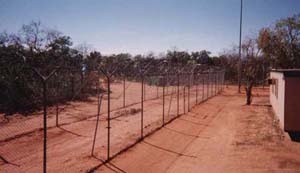
Curtin Detention Centre - recently reopened. The buildings are not insulated. This photo was taken by an asylum seeker.

The government has been framing the debate about asylum seekers in the language of "border protection".

We delineate boundaries over land (and sea) to divide jurisdiction, and people cross those borders all the time.

The act of crossing a border does not violate it. When someone seeks the protection of our jurisdiction, they generally have to cross over the border to obtain the protection of that jurisdiction. There is no need to protect our borders from such people - they are relying on those borders, not threatening them.

That is what seeking asylum means - asking for our help.

If an army were to cross the border, with the object of overthrowing the government, that would be a different matter. To suggest that people fleeing persecution, and seeking sanctuary here, are to be categorized in such a way, is to leave the path of reason.

Australia was instrumental in developing the Refugee Convention in 1951. This was a response to the denial of asylum to Jewish refugees - notably aboard the St Louis in its doomed attempt to take threatened Jews out of Nazi Germany in 1939. We are signatories to the convention.

This week Julia Gillard will make an announcement about "border protection" because the three month suspension of Tamil claims for asylum will expire. Her use of the term "border protection" already shows us how she views this issue.

The right of Tamils (and Afghans) to claim asylum should never have been suspended. In fact, it is clear that the situation for Tamils in Sri Lanka remains dire, and many will be able to show a "well-founded fear of persecution". In Afghanistan, the UN has pulled all its personnel out because it is unsafe.

When there is hysteria about an issue, governments can exploit it for short term political gain, but they do damage to our nation in the process. Their real responsibility is to articulate the values to which we aspire, and to take leadership. Regrettably, that has not happened under Prime Ministers Rudd or Gillard.

The debate about asylum seekers in Australia is fundamentally about ourselves. It's about what sort of community we are and what sort of nation we are. We proclaim our values of freedom and justice, but when people fleeing unimaginable persecution take us at our word, and look to us for help, we lock them up in desert hell holes and we deny them the processes of our law.

Is this who we really are? Is this the legacy we want to leave?

External Links

Saturday, 10 April 2010

Sinking Human Rights

The MV Tampa waiting off Christmas Island in 2001

At the 2001 Federal election the Liberal Party festooned polling booths with bunting displaying John Howard's face, and the infamous words: "We will decide who comes into this country and the circumstances in which they come". (In other words, we will not be bound by our international obligations towards refugees, nor listen to the pleadings of the international community already dealing with far larger numbers of refugees, but we will simply suit ourselves).

We had just had the arrival of the Tampa, and the cruel Pacific solution (with its name eerily echoing another, far worse "solution") improvised to prevent the political embarrassment of having refugees land on our soil. We in Liberty Victoria took proceedings in the Federal Court to challenge the government's treatment of those on board. Bob Brown immediately and publicly condemned the Howard government - in an act of courage which many thought at the time would amount to political suicide. Kim Beazley, who led the Labor Party, refused to take a stand, and lost the 2001 election.

John Howard ruled Australia for a further six years. In that time the modest amelioration of the asylum seeker policy came not from any pressure applied by Labor, but from the Liberal Party's own back bench.

With the change of government in 2007, we thought at first things would be better. The Rudd government did get rid of the Pacific solution, as well as the harsh temporary protection visas, which denied refugees any access to services here. Processing of claims became more streamlined.

But there were ominous signs:
  • the new government did not roll back John Howard's excision of Australian territory to deny ordinary legal process to asylum seekers arriving by boat;
  • the new government did complete the large and expensive - and out of the way - prison for asylum seekers on Christmas Island;
  • the new minister, Senator Chris Evans, rapidly developed a reputation for refusing any of the many asylum claims which required his ministerial discretion to be exercised.
The opposition turned up its xenophobic rhetoric about boat people - in reality only a very small trickle - and the Rudd government went to water.

The government's first major step backwards was categorizing "people smuggling" as a security issue. They have made people smuggling (which of course is code for boat people) something which ASIO and other security agencies must now target.

Can anyone seriously contend that a few people arriving in leaky boats to flee situations of dire personal danger somehow constitute a threat to our way of life, our systems of government, or the integrity of our nation? Any leader who peddles such a ludicrous proposition really does place our country at risk, because they cannot tell a genuine danger from an ersatz one.

And now the Rudd government has decided to freeze consideration of asylum claims for Afghan and Sri Lankan refugees until after the election. This is a display of moral cowardice.

First, it is not true that the situation in those countries is stable and that there is no longer any threat to people fleeing them. Of course, the regimes in Afghanistan and Sri Lanka - each with poor, if not terrible - human rights records, insist that none of their citizens is at risk. Almost no one familiar with the situations in those countries would agree. If the countries of origin really are so safe, why not process asylum seekers now and prove it before the relevant tribunals?

Secondly, each claim should be considered on its own merits. The same approach will not work for everyone fleeing from a country: their circumstances will vary.

Thirdly, to keep human beings locked up behind razor wire to suit a party's political convenience is an act of inhuman cruelty, and it diminishes Australia as a civilized country. Suffering human beings are not political pawns.

Fourthly, the government's actions are in clear breach of our international obligations under the 1951 Convention Relating to the Status of Refugees - which Australia has ratified, and which we helped draft. So our actions also show us to be an unreliable international partner.

The Rudd government could have stood up to the shock jocks and the talkback panic merchants, and they could have swatted away the schoolyard name calling of the opposition - and they would have taken Australia with them. Australians do not want to be racist, to be bad neighbours, or to deny basic humanitarian care.

But the government has lost that chance now. And they have lost far more. They have lost their moral standing as a government, and they have lost any claim to leadership on this issue.

And they have shamed Australia in the eyes of the world.

External Links