Pages

Showing posts with label Bob Brown. Show all posts

Tuesday, 2 November 2021

Environmental values and the Rule of Law


Address to the AGM of the National Environmental Law Association 

13 October 2021


At all levels of government, Australia has a range of statutes, regulations, by-laws, standards, codes of practice, principles, international treaties, and other laws designed to protect the environment.

A law without a practical remedy fails to serve its purpose. Such a law also brings disrepute on the law as an entity.

There are many practical obstacles to enforcing environmental laws in Australia. I want to give a few brief case studies.

Trail bikes

Many years ago, my brother was bushwalking along the Alpine Walking Track on Mount Erica, part of the Alpine National Park.

He was shocked to see trail bike riders illegally riding through the bush, churning up mud, and causing a great deal of damage.

He took the trouble to go to Rawson police station to report the matter. The policeman there told him he would not do anything about it. He did not support the ban on recreational vehicles in the area, and would not enforce it.

There, in a microcosm, is the problem with many of our laws designed to protect the environment – they are useless if those charged with their enforcement will not do so.

Orange roughy


Orange roughy (Hoplostethus atlanticus) was first discovered in Tasmanian waters in the 1980s.

It is an orangeish-red fish, reaching a length of almost half a metre. The skin is poisonous to humans and its oil is powerful enough to be used as a degreasing agent.

Orange roughy is a long-lived and slow growing species. They take 20 to 25 years to reach reproductive maturity. They live for 100 years or more – with good evidence of ages over 150 years. They are found at considerable depth – hundreds of metres to over a kilometre.

The meat of orange roughy survives freezing and packing particularly well, and there is strong demand throughout the world for this fish. It is often marketed as ‘sea perch’. 

After initial minor catches, orange roughy was first commercially fished off Tasmania in significant quantities in 1989.

The fish were taken in greatest quantities whilst spawning, and the major spawning site in Australian waters is located east of St Helen’s at an underwater feature known as the St Helen’s Hill. This is a 400-metre-high pinnacle – or ‘sea mount’ – rising from a depth of 1000 meters. The fish formed a continuous ring, or ‘donut’, around the mount while spawning.

At times other than when they are aggregated for spawning over the winter months, orange roughy are sparsely spread over large areas of deeper waters off southern Australia. But when aggregated for spawning, orange roughy can be taken in large quantities in a very short time. When St Helen’s Hill was first fished, roughy were reported to enter nets at the rate of one tonne per second. It was a very lucrative species.

Because of the slow maturing rate and low reproduction rate of these fish, the stock will take an extremely long time to recover from overfishing. 

The fisheries authorities set quotas designed to preserve the fish – the focus being on the fishing stock rather than preserving biodiversity.

However, within eight years, orange roughy was commercially extinct in Australian waters, and the fishery had collapsed – a pattern all too often repeated in Australia.

The reason for the loss of the orange roughy was systematic, fraudulent under-declaration of catch by fishing enterprises.

In the late 1990s and early 2000s I was involved in a series of cases prosecuting both companies and individual fishermen for false statements to the Commonwealth about their orange roughy catch, and conspiracy to defraud the Commonwealth.

There were several convictions, and some jail sentences. 
·  
Brinkman v Dix (No 2) [1999] TASSC 65

The cases were complex, and it was due to the dedicated work of a team of police and solicitors that these results were achieved. The work included careful reconciliation of a variety of records, as well as, in some cases, covert filming of the unloading of the fishing catch.

Critical in the orange roughy prosecutions was the fact that after each fishing trip, the holder of a fishing licence was required to file returns as to their catch. Our legal system understands the significance of making false declarations and statements. 

Requiring an active statement of this kind is very helpful for enforcement.

Hill and Henderson

On Easter Sunday, 2015, there was no work being done on any logging coupe in East Gippsland.

That day, Ed Hill and Joe Henderson entered a logging coupe, and conducted a detailed survey of logging operations. Their investigations soon showed that the contractors – under the control of the state-owned logging agency VicForests – had illegally logged protected rainforest. This was a crime.

Hill and Henderson prepared a careful report, documented with maps and photographs.

They submitted their report to the Victorian Department of Environment Land Water and Planning – the appropriate body to enforce the law.

DEWLP conducted its own investigation. They concluded that the rainforest had been subject to ‘unwarranted destruction’. They found that the destroyed forest area was large enough to meet the threshold of protection. They criticised the destruction of the rainforest trees – which had no merchantable value. There was no reason to destroy the rainforest.

However, they did not prosecute or otherwise enforce the law, other than to suggest that VicForests review its own guidelines. They said that, despite their own finding that a crime had been committed, a court might entertain a reasonable doubt.

The story does not end there. The Department then prosecuted Hill and Henderson for illegally entering a ‘Timber Harvesting Safety Zone’ – even though this was on an Easter Sunday when no one was put at risk.

Not only was it left to the community to properly oversee and enforce the laws protecting rainforest, but when they tried to do so, the community members were themselves charged with illegally entering this forest.

I travelled down to Orbost to represent these men. In the result the charges were dismissed, as there had not been proper compliance with the requirements to mark out the Safety Zone. This was a technical defence, of course, and as with so many such cases, the court was not able to deal with the substantive justice issues raised.

But the sequence of events illustrates a pattern that is all too common –  a public affirmation, by way of a law, that certain conduct was prohibited, but the private reality of one rule for those who seek to protect the environment, but another for those who are exploiting it.


Bob Brown and Heritage Rivers

Back in 1997-8, I represented Bob Brown – then newly installed in the Senate – on a charge of obstructing lawful forest operations. 

There were no such operations being conducted at the time, and he did nothing to obstruct logging, but we were nevertheless able to show that the coupe which he attended was not a lawful forest operation, as it encroached some 100 metres into a zone protected under the Heritage Rivers Act

·       DPP v Brown [1998] VSC 117

Again, no action was taken to prosecute those who had breached this law. Rather, the State government passed retrospective legislation to validate the unlawful logging.


Litigation to restrain logging

There have now been several cases in which environment groups in Victoria have successfully (and in some cases, unsuccessfully) litigated to restrain VicForests  – the Victorian government logging agency – from conducting unlawful logging operations. 

·      Environment East Gippsland Inc v VicForests [2010] VSC 335, per Osborn J

·      Wildlife of the Central Highlands Inc v VicForests [2020] VSC 10, per McMillan J

·      VicForests v Friends of Leadbeater’s Possum Inc [2021] FCAFC 66

The first two cases resulted in VicForests being restrained from logging. On appeal in the third case, the Federal Court found that although the logging was non-compliant with the legal requirements, and this was likely to have a significant impact on protected species, the logging agency had an exemption from the EPBC Act by virtue of the Regional Forest Agreement.

The sequence of cases has demonstrated systemic inadequacy – almost wilful blindness – of flora and fauna surveys prior to logging, and then no system to enforce potential breaches where they are detected. 

Victoria does have an Environment Protection Authority, but it is still left to community groups to take this difficult, expensive and of course risky litigation.


EPBC Act

In 2015 and 16, Tiphanie Acreman and I represented the Tasmanian Aboriginal Centre in EPBC litigation against the Tasmanian State Government over its plans to open Four Wheel Drive tracks through the protected Western Tasmanian Aboriginal Cultural Landscape – without approval from traditional owners and without seeking approval from the Federal Government under the EPBC Act. That litigation was, in the result, successful, and the proposal has this year been finally abandoned. I see Adam Beeson in the audience, and he was critical in this litigation.

The relevant Tasmanian Minister had informed the Commonwealth of the proposed action, but also said it was not referring the matter to the Commonwealth, as it did not consider that the proposed action would have any impact on the values of the protected area. The Commonwealth – perhaps with an eye to its political fortunes in the relevant area – did nothing.

·       Tasmanian Aboriginal Centre Incorporated v Secretary, Department of Primary Industries, Parks, Water and Environment (No 2) [2016] FCA 168


Aboriginal midden used as a 4wd jump in the Western Tasmanian Aboriginal Cultural Landscape

Under the EPBC Act, the Commonwealth often imposes conditions on approval, but the enforcement of these conditions is sporadic and relies on a co-operative approach. This is quite inadequate where large sums of money are at stake and the temptations to cut corners are real. 

Indeed, the Samuel review into the EPBC Act found:

The compliance and enforcement powers in the EPBC Act are outdated. Powers are restrictive and can only be applied in a piecemeal way across different parts of the Act due to the way it is constructed. The complexity of the legislation, impenetrable terminology and the infrequency with which many interact with the law, make both voluntary compliance and the pursuit of enforcement action difficult.

Strong, independent compliance and enforcement is required

Independent compliance and enforcement functions that are not subject to actual or implied political direction are needed. The functions should be properly resourced and include a full toolkit of powers and systems.

In these cases, in which environment groups undertake litigation to uphold the law, those groups are required, at great expense and personal risk, to go to court when it is usually the accepted role of the State to take action to enforce its laws.

So community groups often find themselves opposed by the resources of government, applied not to uphold the law, but for political ends. 

Where corporate interests are involved (as is usually the case), the corporate parties have the benefit of tax deductibility for their legal expenses, which is not true for community groups who are acting for the public good. In many cases, the risk of adverse costs orders means a real risk of office holders of these organisations losing homes and other assets. It is an extraordinary burden to impose on citizens.

The implicit model behind this is that the government sets out some broad aspirational principles, and then steps back to let those who might be referred to as ‘stakeholders’ fight it out. There is no level playing field: this is stacked in favour of those with the resources to litigate, and with the right political support.

But if that is the model, do our environmental laws really amount to laws as most people would understand them?

It is not enough for governments to espouse environmental values in legislation without establishing its own mechanisms to enforce those laws.

We have a systemic problem, at both State and Federal level, in which powerful interests are able to circumvent environmental laws, and governments have not put in place adequate independent means of enforcing the laws they have enacted.


The Rule of Law

The rule of law is one of the fundamental tenets of liberal democracy. 

Australia’s traditions as a democracy depend upon our adherence to the rule of law.

The rule of law doesn’t just mean having laws and requiring people to obey them – even tyrants have laws. Nazi Germany had laws – and a lot of them - but no one would argue that it was a society subject to the rule of law. The rule of law operates as a check on the arbitrary exercise of power. 

The rule of law is not about ever harsher laws to reinforce power, but the independent oversight of the exercise of power. Governments and corporations, like citizens, must be accountable under the law. The law must be clear, well-known and applied without fear or favour. Justice must be timely, efficient and independent.

Having laws to protect the environment that are only sporadically and unevenly enforced undermines not only the environment, but also, I would argue, the rule of law and our democratic traditions.

We should be astute to ensure – at all levels of government – that laws to protect the environment do not merely espouse values in a general way, but have specific enforcement mechanisms that give them teeth.

Protecting the environment is too important for us to accept anything less.


Sunday, 25 February 2018

A Violent Joke

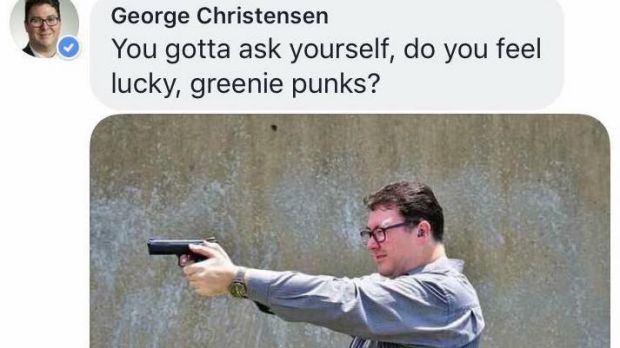
George Christensen's post

Last week, George Christensen posted on Facebook a photograph of himself aiming a pistol, with the caption 'You gotta ask yourself, do you feel lucky, greenie punks?'

It was the day after a school massacre in Florida.

Christensen is the LNP MP for Dawson, in Queensland. He caucuses with the National Party.

The Prime Minister described Christensen's post as 'very inappropriate'.

Christensen refused to apologise, describing the post as a 'joke'. It is not so clear that was the original intention.

He edited the caption to read 'You gotta ask yourself, do you have a sense of humour, greenie punks?' A short time later he deleted the post.

The post was referred to police. Queensland police quickly announced they would take no action. At the time of writing, the AFP are still considering the matter.

Following Christensen's post, Greens Senator Sarah Hanson-Young received an email, with the subject 'bullets' that read: 'Hopefully George has one left in the chamber to fire directly into your vagina you hysterical fucking cunt'.


Christensen's post is no joke.

Christensen's gun-pointing threat to 'greenie punks' comes in a context. There has been sustained and serious violence against Greens and environmental protesters over many years. Most has been perpetrated by the very people to whom Christensen appeals for votes.

In March 1986, during the protests against the Farmhouse Creek logging in Tasmania, Bob Brown was walking down a bush road with conservationist Judy Richter and journalist Hugh Maclean. Shots rang out, evidently aimed at Bob. Maclean, with his Vietnam training, immediately dropped to the mud, leaving the other two standing in shock. Later the shooter was arrested. He was charged with discharging a firearm on a Sunday and fined $200.

Bob Brown manhandled by loggers at Farmhouse Creek in 1986. Later he was shot at.

In January 1990 I was present in a conservationists' camp when two shots were fired in the bush close by. The perpetrator made off. Police in Orbost refused even to take a statement.

In 1991 two cars belonging to conservationists were destroyed by gelignite in the East Picton forest of Tasmania.

In the late 1990s an attempt was made to sabotage the aircraft of Vince Jones, the jazz singer. He lived near Buchan, and was vocal about logging. Steel wool was cut up and deposited in his light aircraft's fuel tank.

In December 1998 Adrian Whitehead was assaulted with an axe handle by a logger. He had been conducting a botanical survey at the time. Despite having an independent witness, the police refused to lay charges.

Adrian Whitehead after being bashed by a logger

After midnight on 3 December 1998 a group of loggers smashed up a campsite of conservationists in the Otways, yelled threats, and drove a vehicle into a tent occupied by two female conservationists who feared for their lives. One logger was subsequently charged and convicted in relation to this incident.

In December 1998 Peter Stienke (“Fisherman Pete”) was by himself minding a conservationists’ camp at Goolengook over Christmas. His car was found at the camp with the door open and food and drinks on the passenger seat. Despite a search by police, Fisherman Pete was never found and is missing, presumed dead. He left a 14 year old son.

On 20 February 2000, some 40 to 50 loggers - some with their children - converged from Orbost and Bombala on a conservationists’ camp in the forest of East Gippsland. They trashed the camp and beat up a Canadian tourist who was there. A carload of conservationists drove up. The conservationists were violently attacked and the car reduced to a wreck. The loggers caused severe injuries to two persons, and threatened to rape the women present.

Much of this was recorded on audio, and it makes chilling listening. The out of control ranting of the loggers, the smashing of iron bars against machinery and people – and the futile attempts of the conservationists to calm the loggers down.

Some of the loggers were identified and later convicted.

On 2 April 2000 loggers wielding baseball bats and axe handles attacked a conservationists' camp at Middle Spur in the Otway Ranges. Police and ambulance were called. Some twenty conservationists were injured, five being hospitalised.

In October 2008 logging vigilantes firebombed two cars belonging to conservationists that were parked on the Strathgordon Road in the Upper Florentine Valley.

There is nothing funny about George Christensen's gunwielding antics against Greenies. Exhortations to violence – whether against greenies, blacks, women, Jews, gays, or any other group in society – are shameful. 'Jokes' like this give licence to those who are inclined to resort to violence, and there are too many of those already.

Political appeals based on violence have a way of spiralling into enormous harm. I can only hope Christensen's gun-toting example will not lead to further violence against conservationists. 

I very much fear it will.

External links

Tuesday, 26 June 2012

Bob Brown


Address at the Greens dinner on Friday 22nd June 2012 to thank Bob Brown on the occasion of his retirement from the Australian Senate

My fellow Greens,
A few years ago, Bob and I spoke at an event in Orange in New South Wales.

On the way back to Canberra, we detoured to drive through Trunkey Creek. There’s nothing flash about Trunkey Creek. It’s a modest settlement that hardly deserves even the name of village. There’s a pub – called the ‘Black Stump’ - an old and now disused general store, a cemetery, and a brick police station with an attached house built in 1879. Bob’s father was the Trunkey Creek policeman, and this is the house where Bob spent his early years. It has cells where, I have it on good authority, Bob’s father, perhaps training his son for bigger things to come, once incarcerated him.

We drove around the settlement, Bob sharing warm memories of what was a pretty normal rural upbringing.

Bob’s background is completely ordinary.

And yet, on that foundation Bob has, by the alchemy of clear-sighted decisions, and being prepared to swim against the tide, built an inspiring contribution to this Earth and to all of us here tonight.

In 1976 Bob, by then a GP in northern Tasmania, was walking down a street in Launceston when a forester named Paul Smith approached him. Paul invited Bob to join him in rafting down a remote river called the Franklin - a river which Bob had never heard of until that conversation. When Bob and Paul paddled down from the Collingwood bridge, disappearing from sight around a bend in the river, they were venturing into a largely unexplored area of Tasmania. On that journey, which opened magic places of remote wilderness to him, Bob named several of the features of the river. At Propsting Gorge he and Paul went into an HEC hut where they saw plans for a series of dams up the river. The rest, as they say, is history.

Galvanized by the imminent threat to this last great wild river, Bob overcame intense shyness to speak with spell-binding force at rallies all around Australia, including our own large rallies here in Melbourne.

In the Franklin blockade, Bob was arrested at the end of 1982. The offence, on conviction, carried a $100 fine, and yet Bob was jailed for weeks because he refused to sign the unreasonable and, as it was later held, unlawful bail conditions which were imposed.

Then, as new year 1983 came in, Norm Sanders resigned from the Tasmanian parliament to run for the senate, knowing that on a recount, Bob would be elected. Bob came out of prison to be declared the new member for Denison that day. Later that same year, the High Court, in one of its most important constitutional judgments, upheld the regulations of the Hawke government which made the Franklin Dam illegal, and the river flows free to the sea to this day.

I say – thanks to Bob, but Bob has always eschewed the role of hero over the Franklin campaign – although he inspired so many. He points to all those who were involved in this campaign. For Bob, his leadership has never been about self-aggrandizement, but always about community.

When Bob stood for election in the Tasmanian state parliament in 1982, the Robin Gray led Liberal Party held a rally in St David’s Park in Hobart. There they released hundreds of balloons adorned with the message ‘Brown is a Green queen’.

I have never seen anything other than magnanimity and equanimity from Bob in dealing with this kind of homophobic reaction to his sexuality. Coming out was an act of grace and courage which was done to help others who were coming to terms with their own sexuality. In the face of the kind of intolerance he faced, Bob never succumbed to it himself.

One of the striking features of Bob Brown’s contribution has been his courage. Bob has been beaten, shot at, had cars firebombed, had a bulldozer drive at him when he was under its scoop, and been frequently arrested - to say nothing of being repeatedly vilified.

He has also showed remarkable compassion. He has travelled to countries like Mexico and Colombia to negotiate the release of kidnapped Greens, and contributed $100,000 of his own money (taking out a bank loan to do so) to arrange freedom for Nigel Brennan, the Australian photojournalist kidnapped in Somalia.

In 2001, when the Howard government sent troops onto the Tampa to prevent, at gunpoint, asylum seekers approaching the courts to secure their rights, it was Bob Brown who spoke out against it immediately. It is worth recalling the political context. An election was due at any time, and Bob faced imminent electoral defeat. Both Labor and Liberal had announced they would preference against him. The Howard government’s action was very popular with many voters.

Bob’s reaction was not to hide, but to call a press conference and state his opposition to this capitulation to Hansonism. Indeed at first it was only Bob who took a stand. It took the Democrats 24 hours to condemn the Howard government. Kim Beazley remained resolutely irresolute – trying to make himself a small target right up to the time he lost the election.

Many pundits predicted that Bob’s reaction was electoral suicide, but it was Bob’s very willingness to put himself on the edge which saw the Green vote go up a gear at the election in November 2001. We jumped from 2% nationally to 5% nationally. Bob was able to achieve election in Tasmania without the preferences of Labor or Liberal. And under Bob’s leadership, how far we have come since then? A national vote in excess of 10% and the balance of power in both houses.

We have seen Bob speak out again and again – addressing the huge rally here in Melbourne on the eve of the invasion of Iraq, and who can forget Bob standing up in Parliament to confront George W Bush about the treatment of Australians in Guantanamo?

Bob likes starting things. Not just the Wilderness Society – which formed at his home in Liffey - but also the Greens, which he built in Tasmania and then across Australia with numerous meetings, and in 1991 when he won the Goldman Environmental Prize (the Nobel Prize for Greenies), he used the prize money to found Bush Heritage Australia, which now manages 1 million hectares of Australian land for its biodiversity and employs over 70 staff, with an annual budget of $20 million. Last year Bob donated his beloved Liffey to Bush Heritage Australia.

Anyone who has spent time with Bob, or read his writings, knows that the fine detail of nature brings out the best and most lyrical in him. With my family I walked with him to Mt St Gwinear in the Baw Baws once. Bob was very steady and present to the bush around him – sometimes stopping to photograph tiny details, alert to all around him and taking in all it had to offer.

How do we thank you, Bob, for a lifetime of service?

I first met Bob in Hardware Lane 33 years ago. Bob’s been there all my adult life – a figure so often able to express what is right even while I’m still struggling to find it. A moral compass for our nation. A beacon for the planet.

Our small thanks tonight cannot augment the sparkling gifts you have given to the Earth and to us all in your career, Bob. But we offer it, and we are inspired by your example to serve the Earth and our fellow beings to make this world a better place.

Please charge your glasses, and let’s drink a toast to our Bob Brown. 

Thursday, 7 October 2010

Senator Bob Brown launches the Melbourne Campaign


Inspirational Greens leader Senator Bob Brown launched Brian's campaign for the state seat of Melbourne on Monday 11 October at the Auditorium, Melbourne City Conference Centre.

Trent McCarthy was Master of Ceremonies. Adam Bandt (Greens MP for Melbourne), Brian, and Senator Bob Brown spoke at the launch.

We've already shown what we can do at the Federal level with strong grass roots campaigning, and commitment to values like compassion, equality and sustainability. We heard that Melbourne is very close, and everyone's vote will be powerful.


Brian Walters

Senator Bob Brown

Adam Bandt MP - federal seat of Melbourne

Photos


Local people explain why they are voting for Brian

A good turn out
Adam Bandt MP, Melbourne (federal)

Brian Walters

Adam Bandt MP, Brian Walters, Senator Bob Brown

Sally Polmear and Senator Sarah Hanson-Young

Senator Bob Brown
Photo credits: Peter Campbell


More photos

Saturday, 4 September 2010

Goolengook


Just after Bob Brown was elected a Senator in 1996, I walked out of court at lunchtime. I was in Hobart, prosecuting orange roughy fishermen for fraudulently understating their catch.
I turned on my mobile and it rang. It was Margaret Blakers, Bob Brown’s personal assistant. She told me Bob had just been charged with obstructing lawful forest operations at Goolengook forest in East Gippsland.
As it happened, I already knew that, because his photo was all over the front page of the papers that morning.
Now it was for me to act for him.
The first concern was the prospect that if he was convicted of any serious offence, he might be disqualified from taking his seat in the senate. When I later met with Bob and his advisers, there was discussion about how the court case could be used to highlight the plight of the forests, but I had a different perspective: the way to get good publicity was to win the case, and I thought we could.
I had a good team, with fellow barristers Klaus Mueller and Brad Baker, and some diligent instructing solicitors, including Bill Coady and Bill Lambros.
Goolengook was spectacular forest, and had been the site of a long running logging blockade.
The charge was obstructing lawful forest operations. In fact, there was no logging occurring at the time, and nothing to obstruct. But more importantly, the prosecution would have to prove that the logging was lawful, and I was not sure that it was: the logging on which the police relied was carried out next to the Goolengook River - listed as a heritage river under the Heritage Rivers Act.
The Heritage Rivers Act recognised the Goolengook River as having the best continuum of rainforest in Victoria, and made logging unlawful in the area it had protected. That area was defined by reference to a map. We had to go to the Surveyor-General's office to obtain a copy of the map which was referred to in the Act.
Looking at the map, and looking at the logging coupe plans, one thing leapt out at me: the Act required that there be 200 metre buffer zone either side of the river, but the coupe plan purported to allow logging to within 100 metres of the river.
The logging was in breach of the Heritage Rivers Act, and Parliament had set out in the Heritage Rivers Act (s 15 of the Act at that time) that the Act was to prevail over other Acts, and any instrument (ie document) authorising a contravention of the Heritage Rivers Act was "void".
In due course we travelled to Moe Court to defend Bob Brown and two others who had been charged with him. The fate of several hundred other protesters - who had also been charged - would depend on this case.
The police witnesses gave their evidence. They included the foresters who had drawn up the coupe plans and authorised the logging. None of them had considered the Heritage Rivers Act, and none of them had looked at the map which Parliament had said should prevail over any other logging rules.
It was clear that the prosecution could not prove that the logging was lawful, and after three days of hearing (extending into early 1998) the case was thrown out.
The Kennett government was embarrassed by the outcome. It dropped the charges against all those who were charged, and suspended logging in East Gippsland for the remainder of the summer - the court ruling meant that the East Gippsland Forest Management Plan was "void" in its entirety, and they had to start again.
The government introduced legislation to retrospectively validate the logging plans, and to amend the strong protection in the Heritage Rivers Act. It reduced the buffer zone from 200 metres to 100 metres. The government also introduced legislation making it an offence to enter a "forest operation zone" - large areas where logging might or might not occur.
They also appealed to the Supreme Court against the dismissal of the charge against Bob Brown.
The Supreme Court hearing came on late in 1998. I was opposed by Susan Crennan QC, now a High Court Justice. Justice Kellam reserved his decision, and we came back on 23rd October (which happened to be my wife Sally's birthday) to hear the result.
Justice Kellam found that the prosecution argument faced "insuperable obstacles" and threw out the appeal. He confirmed that the charge against Bob Brown remained dismissed, and ordered costs against the prosecution.
It took many more years to save Goolengook, but that night, at least, we all went out to a restaurant in Southbank and celebrated!
External Links

Wednesday, 1 September 2010

The Gunns 20


The Gunns 20 in Hobart
In mid 2004 I had lunch with Bob Brown to discuss some legal issues, and I gave him a copy of my book "Slapping on the Writs" about the use of strategic litigation to silence community groups.
On 13th December 2004 I was on my way up to Brisbane with my family for my niece's wedding. Our first night's stay was to be at Dubbo. I was just starting to unwind after a long drive, when I turned on my phone. It lit up with missed calls.
Then it rang: it was Bob Brown's adviser Marg Blakers. Had I heard the news? Australia’s biggest woodchipper and Tasmania’s largest company, Gunns Ltd, had just issued a writ out of the Supreme Court of Victoria against 20 (mostly Tasmanian) environmentalists, including Senator Bob Brown and the Wilderness Society. The writ claimed damages of more than $6 million for “corporate vilification” and “conspiracy to injure by unlawful means”.
I did some media interviews that night, and I'm sure I annoyed my family on that trip with long calls about strategy to various people whenever we were in mobile phone range.
My friend Dr Suresh Pathy, an anaesthetist, rang me when we were somewhere near Armidale. He was the secretary of Doctors for Native Forests - a Victorian group, and the twentieth Defendant: "They've got the wrong party!" he said. "We don't operate in Tasmania. The 19th Defendant is supposed to have said something on our behalf, but we don't know him. He's not part of our group, and he wasn't speaking for us."
In Tasmania, there is another group called "Doctors for Forests" which operates in Tasmania - there are no formal links between the two groups.
On 15th December 2004, two days after the writ was served, Gunns announced that it intended to build a large pulp mill in the Tamar valley. The reason for the issue of the writ now became obvious: it was intended to distract and silence opponents to its project.
The "Gunns 2o" as Bob Brown called the defendants, stood together in Hobart with tape over their mouths to symbolize the attempt to silence them. Many knew they stood to lose their homes from this litigation, and were in deep distress.
In due course I was briefed, along with Noel Russell, to act for Doctors for Native Forests. Vanessa Bleyer was our instructing solicitor.
The writ was extremely lengthy (227 pages). In the "Statement of Claim" which set out its allegations in detail, Gunns took exception, amongst other things, to conservationists’ correspondence with the Japanese buyers of Gunns’ woodchips in which they were asked to “review and cease … sourcing of native woodchips from Tasmania”. There was a complaint that representations were made to the Banksia environmental awards to oppose Gunns being included as a finalist. There were many complaints about public statements by opponents to logging.
All these actions of engaged citizens participating in the decisions that affected them were labelled conspiracy - it was a neat trick, redefining democracy as "conspiracy".
The statement of claim was bizarre, and included completely novel causes of action.
We wrote to EMA Legal, the solicitors for Gunns, and told them they had sued the wrong party.
Eventually a lengthy reply came, denying any mistake, and demanding damages and referring to a private email Suresh Pathy had sent to members of the group.
We asked them to pay half our costs to date, and gave them 7 days to think about it.
The first question to ask yourself about a statement of claim is: "Can I understand it? Do I know what the allegations are?"
It did not take long, looking at this convoluted and confused document, to realize that we had no hope of mastering what the case was against our client - Doctors for Native Forests - and we did not think any other defendant would be in any better position.
A team of counsel assembled to defend the writ. Most other counsel in the case were at first reluctant to take the step of applying to have the Statement of Claim struck out. In a long meeting in the chambers of Mark Dreyfus, Noel and I finally prevailed, and it was agreed by (most) other counsel to join us in the application to strike out the pleading.
The hearing was listed for 4th July 2005 - a Monday. After 5 pm on Friday 1st July (the last business day before the hearing) Gunns served us with a proposed amended Statement of Claim. This time it was 360 pages long, and even more complex.
Gunns expected us to seek an adjournment. They wanted to keep the bird aloft a bit longer, even though it didn't have a feather to fly with.
All weekend, to all hours, we worked on mastering the new document.
On the Monday morning counsel for Gunns announced that there would be yet further amendments, by way of "particulars" (this is where more detail is provided of specific allegations), and said that the material ought to be considered as a whole. He did not make clear what he was asking for but after ten pages of transcript the judge asked:
So you're seeking an adjournment effectively of today's application?
In a long answer, counsel for Gunns eventually conceded that he was. Counsel for the defendants opposed the adjournment, pointing out that we had been asking for particulars for months and had effectively received nothing, and did not expect anything further now.
The adjournment was refused.
We then argued the case for the remainder of the week. On 18th July the judge delivered his damming assessment of the Gunns writ - in both forms. It was struck out. The judge described it as "embarrassing", "confusing", "complex" and "unintelligible".
A third Statement of Claim was then delivered some months later. Again, we applied to have it struck out, and again the judge threw it out with a damning assessment.
The Gunns case was now in serious trouble. The adverse publicity had seen the Gunns share price plummet. Gunns sacked its lawyers and hired a new team.
At this point Gunns dropped the case against Doctors for Native Forests, and agreed to pay all costs.
The case then collapsed against a number of other defendants, including Bob Brown, and bit by bit the Gunns litigation unravelled.
Finally, on 1st February 2010, Gunns abandoned the case against the remaining four defendants, and agreed to pay them over $150,ooo in costs.
Gunns ended up paying several millions of dollars in costs to the defendants, to say nothing of what it paid to its own lawyers. But for many of the defendants it was an immense strain, imposing real financial and personal costs - just because they had stood up to a powerful company.
The Gunns litigation was a try on by well resourced plaintiffs who were determined to tie up their political enemies in court for as long as possible and as expensively as possible.
Litigation like this brings our legal system into disrepute, and should be outlawed by legislation.
External links